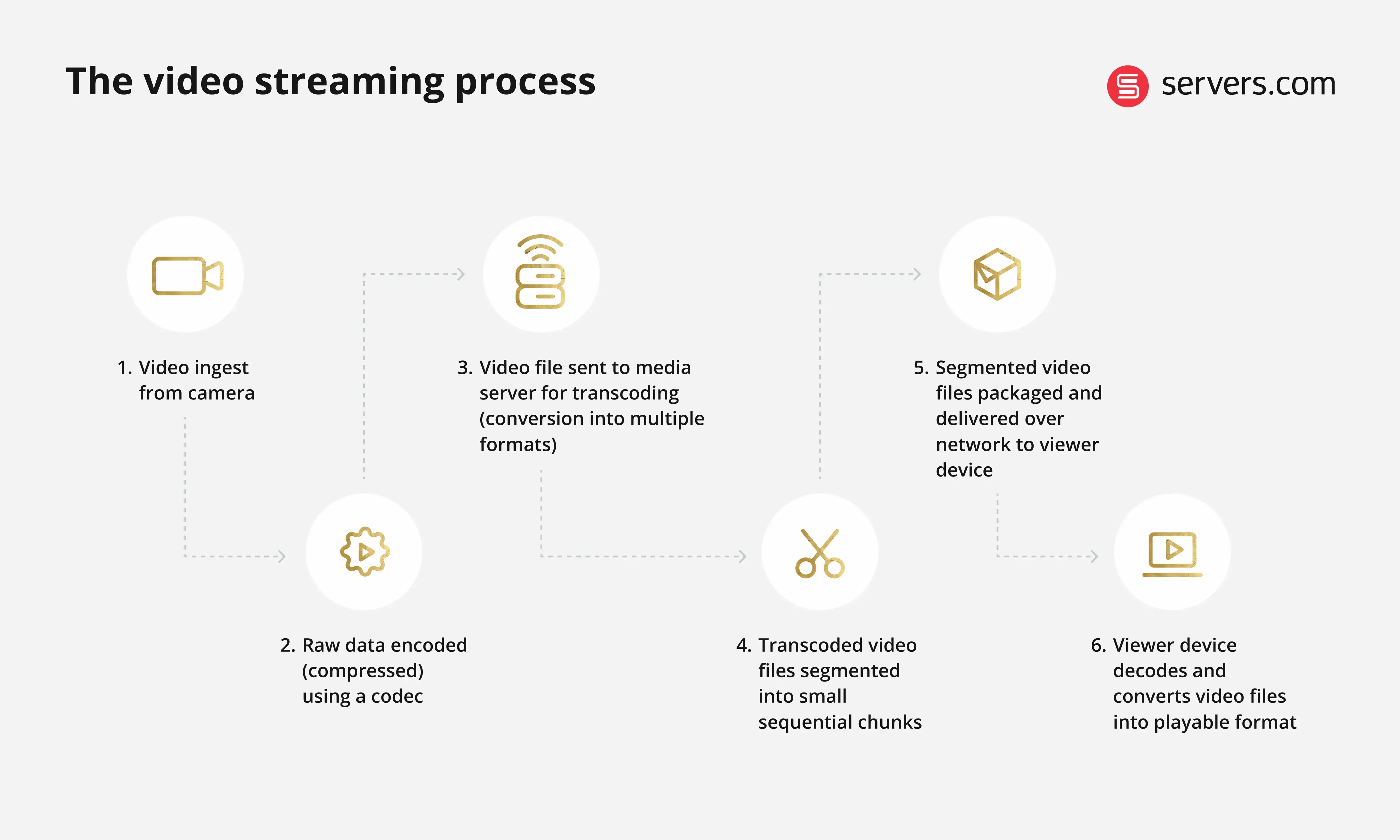
In the case of live streaming, video signals are converted into a compressed digital signal and multicast over a web server.
When streaming to dispersed audiences, it’s common to use a geographically diverse network of servers called a content delivery network (CDN). CDNs allow media files to be stored at the “network edge” closer to the end-user’s physical geographical location to improve the delivery and performance of streams.
Best practices for streaming at scale
The global success of OTT streaming services, including the likes of Netflix and Disney+ as well as live streaming platforms, also comes with mounting challenges. The wider and more geographically dispersed the audience, the more streaming challenges and potential points of failure. Physical equipment can break, demand surges can cause downtime, networks can fail – and all of this directly impacts viewers.
According to a paper released by InterDigital, over half (57%) of sports viewers face challenges, with one in five reporting poor quality video from a streaming service.
The architectural demands of maintaining seamless performance and uptime when streaming to global audiences are huge. But there are provisions that platforms can put in place to overcome these streaming challenges and improve the quality of global broadcasts.
1. Build for failure
One of the biggest streaming challenges is the many potential points of failure. According to New Relic’s 2025 Observability Forecast for Media and Entertainment, the median cost of a high-business-impact outage is $2 million per hour and is the leading cause of downtime.
It means building redundancy into your infrastructure is the first rule of streaming at scale. Identify the most critical potential points of failure and invest in building redundancy for those areas. When it comes to your underlying infrastructure, there are four categories of redundancy to consider: in-server redundancy, backup, building resiliency across multiple dedicated streaming servers, and disaster recovery planning.
“You need to go through that stuff ahead of time,” says Adam Miller, CEO of Nomad. And that means planning out as many scenarios as possible from disaster to recovery.
That’s exactly the approach Meta took when first preparing to scale live streaming to millions of simultaneous viewers via Facebook Live and Facebook Watch. As content expanded to include shows and event coverage, Meta had to find ways to support broadcast-quality live streams at scale. To do this Meta built in redundancy at every point in its delivery infrastructure from transport through to playback to ensure that it could withstand most types of failure and support streams with unprecedented viewership.
Many large-scale live streaming services also use bonded internet connections to ensure reliable broadcasts. It involves using multiple simultaneous internet connections and an algorithm to distribute incoming data packets amongst the available connections. Bonded connections add an extra layer of redundancy by ensuring that the volume of data distributed to each internet connection corresponds to its relative strength. This means no connection will ever be given more than it can handle.
2. Leverage the edge
As the pressure on content providers mounts, the capabilities of a traditional CDN are increasingly falling short. This is because most CDNs are located either at distributed data centers or various points of presence (PoP) within the internet exchange. Whilst this does help limit the distance content must travel to reach the end user, these systems are still too centralized to guarantee high quality end-user experiences.
To stream at scale and deliver the real-time responses that end users expect, content providers are turning to the edge. Edge CDNs are deployed at core nodes in the inner and outer network edge. Caching content at the network edge results in a faster transfer of data, better quality of service for end users, and a lighter centralized data load resulting in increased network capacity. It’s exactly the approach that Netflix takes, particularly for synchronized viewing experiences like sports and special events when even small delays can impact the viewer experience. By publishing rapidly produced segments to geographically distributed edge locations, Netflix reduces load on central origin servers and minimizes latency to their viewers.
3. CDN load balancing
Load balancing is integral to effectively manage CDN traffic for global live streams. Distributing traffic across multiple CDNs reduces the load on each and improves efficiency. When streaming globally, the most effective approach is to organize traffic distribution by region. Much of the time this comes down to identifying which CDNs have the best streaming infrastructure in particular geographies, so the best starting point is researching which providers are the dominant players in your required regions.
4. Machine learning (ML)
Netflix is a great example of how intelligent integration of AI and ML capabilities can be combined with existing systems to achieve streaming at massive scale. Streaming to over 300 million global subscribers comes with significant technical challenges. To provide high-quality streaming experiences to its ever increasing usership base, Netflix uses AI and ML technologies across a range of use cases. This includes localization agents to scale global content efficiently, streaming quality agents to maximize quality of experience, and auto-remediation agents to automate the resolution of data infrastructure errors.
5. Embrace innovation
As streaming continues to gain popularity globally, new technologies designed to improve video distribution are regularly emerging. This includes technologies like Media over QUIC, a new open-source streaming protocol developed by the Internet Engineering Task Force.
The reason MoQ is so game changing is because it is a single protocol for ingest, distribution, and interactive use cases. It’s one technology suitable for all real-time data transfer use cases - with no need to transcode between different technologies. Additionally, the protocol is capable of enabling sub-second latency and broadcast at scale, and bypasses common performance bottlenecks like head-of-line blocking.
Testament to the speed of tech innovation in the streaming space, even though MoQ has not yet been released as a finalized standard, the industry has already embraced its adoption. For example, at IBC 2025, real-time live streaming platform, nanocosmos, announced a first-of-its-kind MoQ implementation that will deliver end-to-end latencies under 500 milliseconds.
The secret to global streaming success
In 2026, streaming has already reached global audiences. For streaming platforms today, the challenge lies in ensuring those global audiences are met with perfect stream quality every time. And, needless to say, this comes with mounting technical challenges.
Challenges like maintaining video quality over unpredictable networks, delivering content to geographically diverse audiences, and contending with multiple potential points of failure.
It’s not an easy assignment, but the success of major global SVOD and AVOD platforms have already shown us that it is achievable. At the same time, continued innovation of streaming tech is successfully producing frameworks in which global streaming can continue to flourish. For platforms, the key ingredients to success remain simple: build for failure, embrace innovation, and leverage the edge.