The domination of streaming services naturally gives rise to the next battle for OTT platforms, which is: competing with other OTT platforms. How many times have you been recommended a TV show by a friend, only to find out you don’t have a subscription to the service it’s on? Yep, me too.
It’s no surprise either, as the list of networks is seemingly endless: Netflix, Amazon Prime, Disney +, Paramount +, Apple TV, just to name a few. In fact, as of May 2025, Neilsen notes that “along with the 71% increase in streaming usage, six additional streaming services are now reported in the list of platforms that exceed a full share point of TV usage”. Each of these platforms are trying to outclass the others in what has been dubbed “the streaming wars”.
That was until Netflix took a decisive victory with the announcement of their intended $82.7 billion acquisition of Warner Bros. The move sent a clear message to the rest of the market. By combining global distribution with one of the deepest content libraries in the industry, Netflix raised the bar for what scale now looks like in streaming.
As competition intensifies in 2026, platforms will rely increasingly on:
Exclusive content: having a TV show or a film produced by a network is one of the most effective ways to market a platform; trailers and promos building the anticipation towards a new show is inherent marketing for the platform on which it sits.
AI-driven personalization: with so much media being produced for streaming, platforms are using AI to make sure that the right content is hitting the right people. Algorithms that recommend to viewers what they might be interested in are already commonplace, but we’re seeing an increase in AI for several other purposes.
AVOD models: Advertisement-based video on demand (AVOD) also uses AI to analyze audience data to ensure viewers are seeing personalized adverts, helping OTT platforms identify the most profitable opportunities.
There’s no doubt we’ll see much more of this throughout 2026. Using AI to personalize discovery, tailor advertising through AVOD, and present content in ways that resonate with individual audiences will be key tools for platforms looking to win and retain viewership in an ever more crowded streaming landscape.
3. The growing presence of 8K video over IP
According to Demandsage, video will account for 82% of global internet traffic in 2026. With more users consuming HD 4K and even 8K content via streaming platforms, the demand for data has soared.
Good quality 4K streaming needs a content bitrate of at least 20MB/second. But it isn’t just 4K that is putting the pressure on our physical infrastructure: 8K video over IP is emerging as the next in line for high-definition streaming.
If 4K needs a content bitrate of 20MB/second, 8K will need anywhere from 60-90MB/second. Currently, there is only a handful of 8K televisions on the market, and there isn’t a huge amount of 8K content available to stream. What is certain however is that OTT platforms must upgrade their infrastructure to handle its higher bandwidth needs. This may involve any of the following:
Optimizing network configurations. Adopting advanced video compression techniques such as HEVC or AV1 to reduce data usage without compromising quality.
Implementing quality of service (QoS) protocols. Monitoring network performance and implementing automated scaling to prioritize video traffic and adjust resources based on demand.
Considering our worldwide bandwidth is already being pushed to its capacity with 4K streaming, developments in video over IP are outpacing that of our physical infrastructure. This really is a global concern, and one that needs to be addressed before 8K streaming becomes readily accessible, cheaper, and at the forefront of consumer demand.
4. The growing adoption of ASICs
If 2024 and 2025 saw companies introduced to ASICs, 2026 will see them being deployed at scale. ASICs are specialized chips built into a server that are designed for one task in mind. With all their compute being directed into one task, they are incredibly efficient in terms of speed, power usage and space. For streaming, that job is predominantly video encoding.
NETINT Technologies Inc. estimated that if Google was to encode 500 hours of video per minute with CPUs, they would need 2.2 million servers. If you think that sounds bad, encoding videos for a platform the size of YouTube in AV1 could require over 100 million servers. Need I say more?
This is where ASICs come into play. As they can be specially designed for encoding and decoding video content, streaming infrastructures can efficiently manage this process without having to erect a data centre the size of a small country. As reported by CNET, “Argos (Google’s own ASIC-based transcoder) handles video 20 to 33 times more efficiently than conventional servers when you factor in the cost to design and build the chip, employ it in Google’s data centers, and pay YouTube’s colossal electricity and network usage bills.”
What really changed in 2025 was how mainstream this technology became. Beyond pure video workloads, these chips are increasingly being paired with AI-driven processes, allowing platforms to handle both media and intelligence at scale without dramatically increasing power or rack space. As such, I believe their presence within streaming infrastructure will only continue to grow over the next year.
There are no signs of slowing down
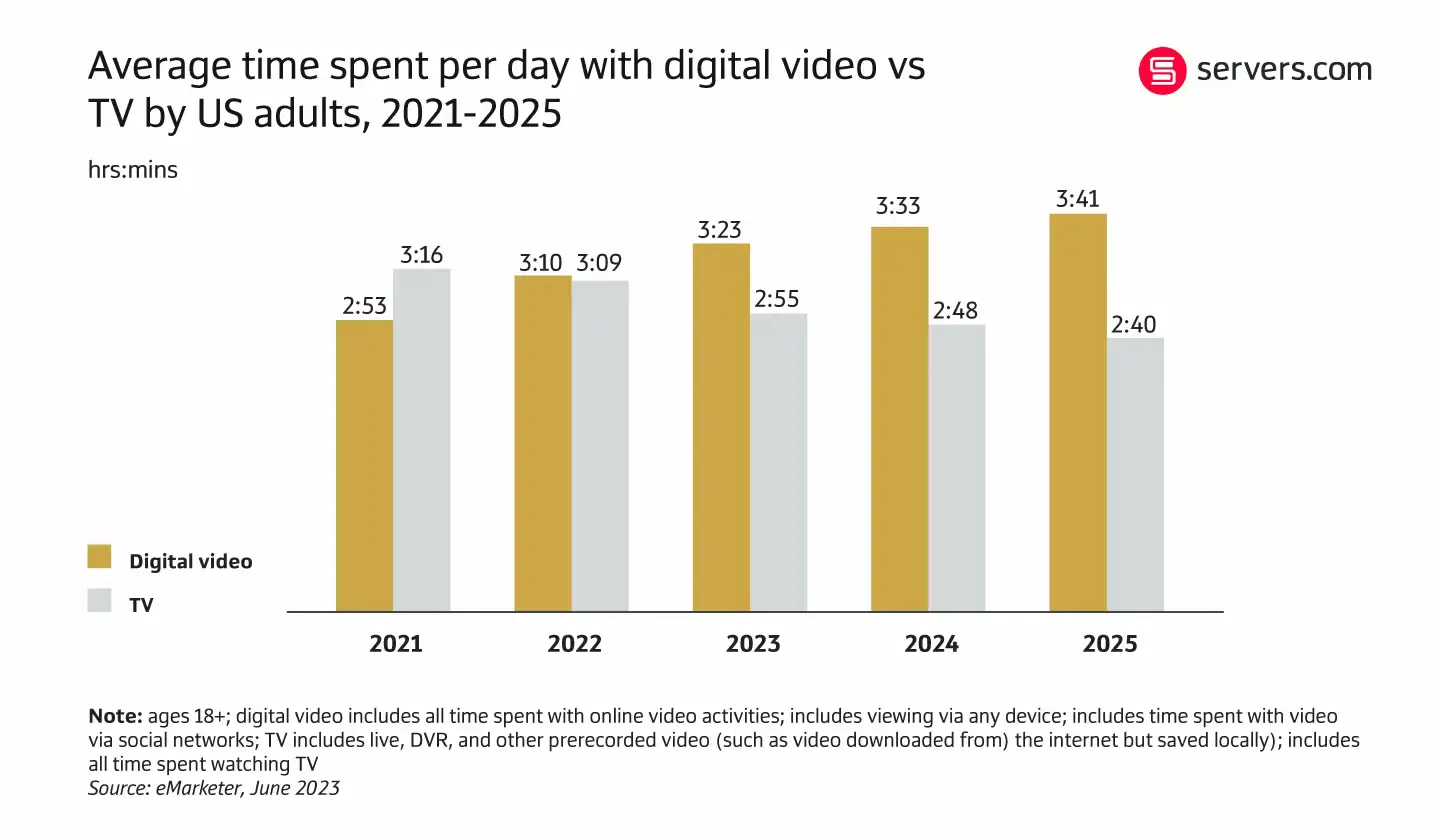
Streaming has become the most popular method of consuming media. As traditional TV usage declines, the balance tilts in the favor of OTT platforms, fueling a competitive battle among them to see who can come out on top.
In 2032, the video streaming industry in the US alone is estimated to reach a value of $610 billion. By that time, thought leaders are expecting to see the adoption of AI become front and center of not just algorithms and workflows, but the production of films and TV shows as well.
Strategist Mark Minevich, writing in Forbes, believes we are approaching a “crisis of innovation” with “data centers reaching their limits”, acknowledging the need for infrastructure to keep up with the pace of AI advancement. “Organizations that invest in advanced infrastructures and energy solutions will be in the right place to benefit from this changing perspective... the firms that are only intelligently able to adapt to the future by optimizing AI and solving sustainability and digital sovereignty will be the frontrunners.”
I, for one, can’t wait to see what the industry will look like in five years’ time. But until then, what streaming trends are you predicting for 2026? I would love to hear your thoughts on the above or anything you feel I’ve missed. You can reach out to me over on LinkedIn.