Network
Table of contents
As digital businesses scale globally, where your infrastructure lives is critical. Organizations today are operating in an increasingly challenging ecosystem in which users expect instant experiences, regulators demand tighter control over where data is stored and processed, and recurring cloud outages expose the risks of single-region dependencies. It means data center location plays a decisive role in application performance, regulatory compliance, and operational resilience.
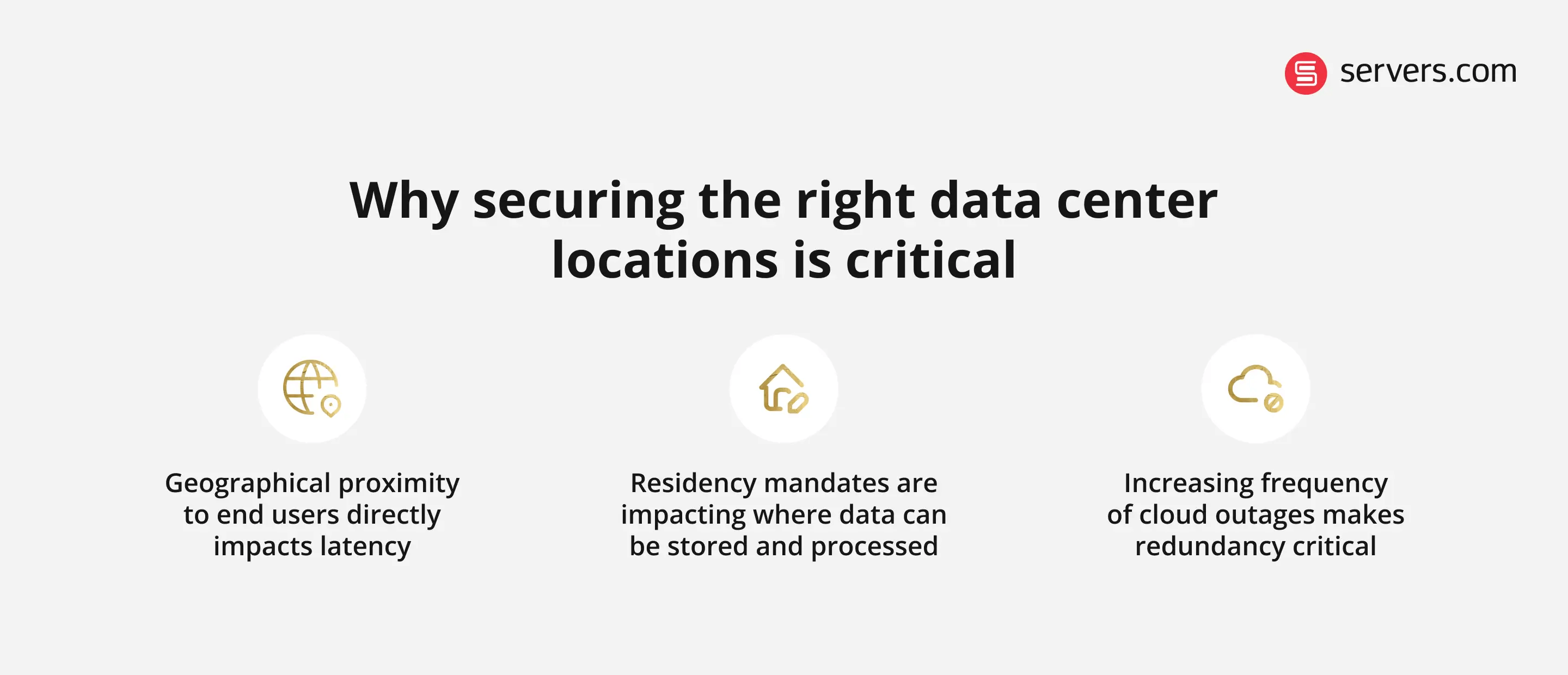
Three key factors make data center location critical: latency, compliance, and resilience.
Geographic proximity directly impacts latency. As digital services expand into new regions, placing compute near end users is a key factor in ensuring consistent, high performance. Data center location choices are also being shaped by emerging data sovereignty and data residency requirements that dictate how and where organizations store and process their data.
At the same time, the impact of increasingly frequent major hyperscale cloud provider outages cannot be ignored. These events have reinforced the critical need for geographically separated failover capacity and the importance of avoiding single-region dependencies.
Ultimately, securing compute in the right locations is more important than ever – and it means partnering with the right global IaaS providers is essential.
When you’ve got strict locational requirements, finding the right IaaS provider can be challenging. Providers may claim global scale, but underlying capabilities (availability, network quality, regulatory readiness) vary widely.
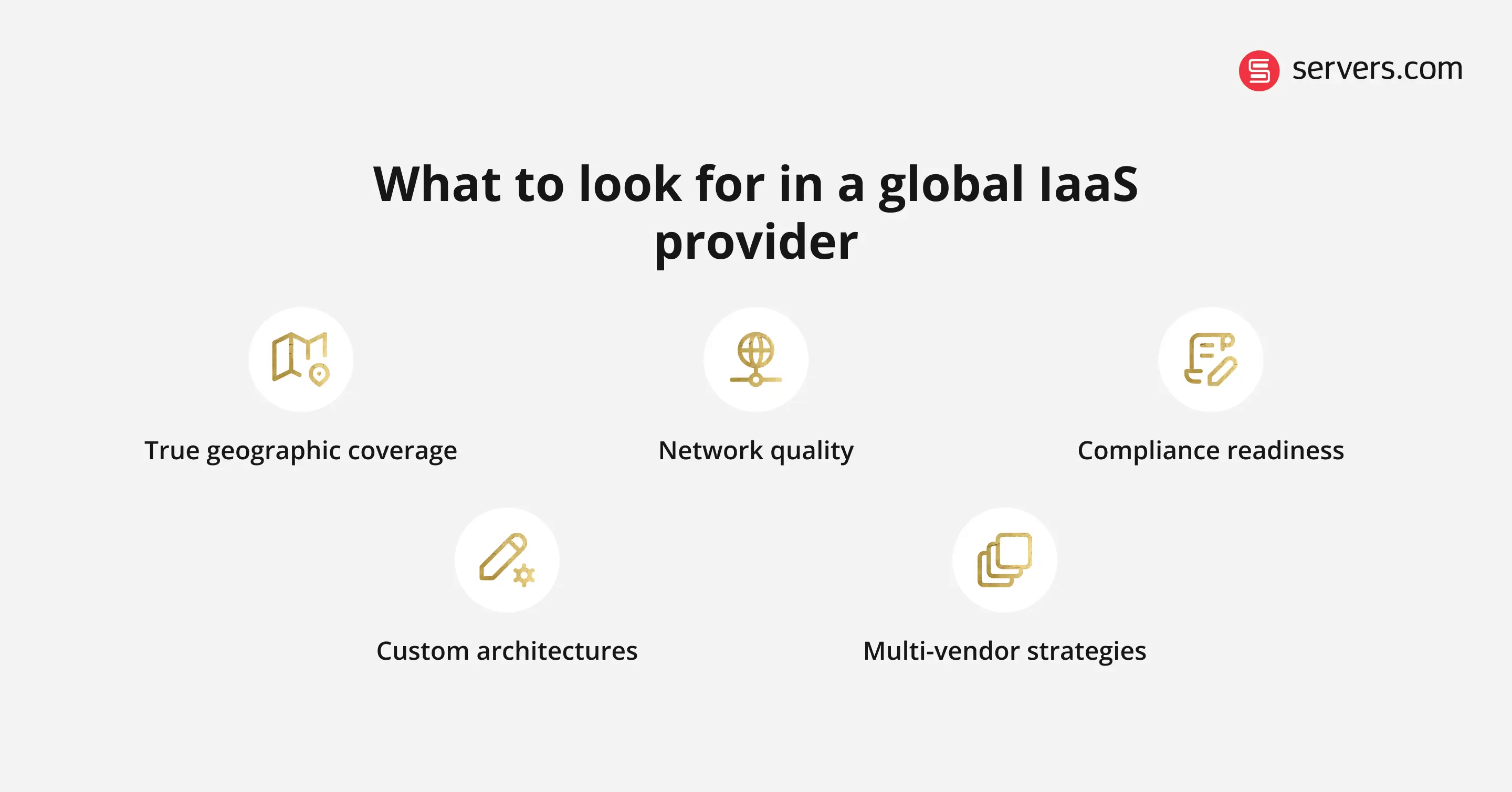
Below are the core criteria you should be considering when assessing the geographic suitability of an IaaS provider’s offerings.
For global businesses, having infrastructure in strategic regional locations is essential both for proximity to market hubs and to reduce latency to end users in those regions. Because of this, it’s important to partner with vendors offering diverse geographic coverage that aligns with your target markets (even better if you can select the exact facility in which your hardware sits). This helps ensure your hardware is located as close to end users as possible.
It’s also worth noting that vendors tend to specialize in specific regions. Don’t be afraid to adopt a multi-vendor strategy and make use of different provider’s data center locations – this is an effective way to optimize your business’ points of presence (PoPs).
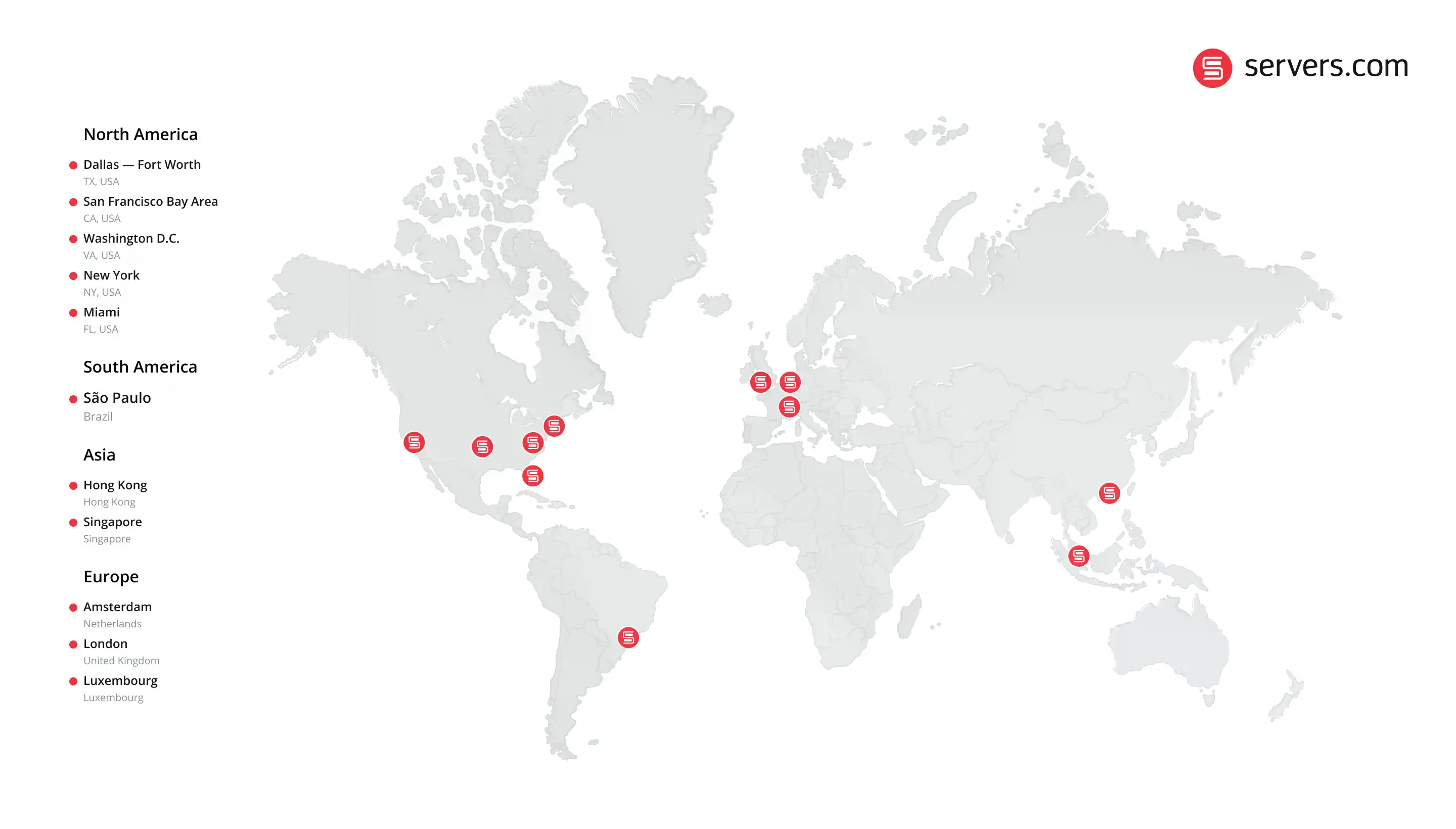
servers.com’s data center footprint spans the United States, Latin America, Europe and Asia Pacific. And within these regions, specific facilities are strategically located based on proximity to key markets, low latency network intersections, and compliance zones.
Launched in December 2025, servers.com’s newest facility in São Paulo, is a first entry into the LATAM market. São Paulo provides an international connectivity channel to the U.S., Europe and Africa and benefits from a favorable regulatory environment, dense concentration of enterprise and financial institutions, and the largest internet exchange point in the Americas.
Furthermore, the specific facility in Tamboré Barueri, is ideally located to offer access to major IP transit carriers and low latency to major corporate and financial districts. Marat Gainullin, Head of Service Delivery at servers.com explains why this location is so important:
“Our decision to launch in São Paulo is a direct response to what our customers have been telling us. They need reliable, high-performance compute closer to their users in Latin America. São Paulo is one of the most strategically important digital hubs in the world, and expanding here strengthens our global infrastructure footprint while enabling our clients to deliver lower-latency, regionally compliant services at scale.”
For a full overview of servers.com’s current data center locations, review the table below. All our data center locations are influenced by customer demand. If you need compute in a region not currently listed, get in touch to discuss your requirements.
| Region | Location | Strategic importance |
|---|---|---|
| United States | Dallas Fort Worth | Access to the largest connectivity hub in the middle of the west and east coasts. |
| San Francisco Bay Area | Access to the world’s largest center for high technology and innovation. | |
| Washington D.C. | Access to Northern Virginia - the largest data center market in the world. | |
| Miami | A crucial connection point between North America, South America and the Caribbean. | |
| New York | One of the most network-dense regions globally, with proximity to major markets. | |
| Latin America | São Paulo | Access to Latin America’s largest digital infrastructure hub. |
| Asia | Hong Kong | Direct connectivity and low latency access to mainland China. |
| Singapore | Access to the major Asia-Pacific digital connectivity hub. | |
| Europe | Amsterdam | Gateway location for pan-European data flows. |
| London | Access to the world’s largest financial ecosystem. | |
| Luxembourg | One of the safest regions for data privacy and storage inside the European Union. |
Last updated February 2026
São Paulo is one of the most strategically important digital hubs in the world, and expanding here strengthens our global infrastructure footprint while enabling our clients to deliver lower-latency, regionally compliant services at scale.
A global map means little without a strong network architecture underpinning it. For latency-sensitive workloads, the network is often the most critical variable. This is because factors like physical distance, routing efficiency, congestion, and jitter directly determine response time and tail latency. Compute can be placed anywhere, but poorly designed network paths and variability will quickly negate geographic proximity.
To ensure access to robust network architectures, look for providers that offer carrier diversity, redundant (and customizable) network routing, competitive latency SLAs and consistent global performance with minimal regional variation.
With a modern and redundant network, servers.com hardware is connected to three different networks: the internet, an out-of-band management network, and servers.com’s Global Private Network (GPN) offering 20 Gbps to each server and physical and logical protection to ensure fast and safe data transfer.
As L3 fabrics, both the private and public networks allow for high bandwidth utilization, fast failover, and predictable latency. And with access to top IP carriers (including Lumen, Comcast, Cogent, NTT, Telia and regional providers), servers.com customers benefit from well-peered global networks that improve speed and reduce the risk of outages thanks to their redundant backbone infrastructures.
It's what attracted VOISO to servers.com. The team’s AI-driven contact center solutions depend on Voice over Internet Protocol (VoIP) technology and real-time data transfer, so latency dictates end-user experience. As CRO, Gregor Potocar explains, partnering with an IaaS provider with a robust network architecture was essential:
“Before choosing servers.com, we evaluated several aspects, including the need for a robust network, the locations available, the flexibility of the services offered, and of course support and pricing. servers.com stood out thanks to its excellent network, which has multiple connections at each location and leverages top-tier providers, overall service stability, its well-distributed data center locations and the excellent support.”
Global businesses must comply with regulations set by the jurisdictions within which they operate. Across regions, governments are imposing data sovereignty and localization mandates that require data to be stored and processed domestically. In some cases, transfers are also subject to specific contract mechanisms.
For example, a business subject to European GDPR mandates may need dedicated server hosting in Europe specifically because they cannot freely transfer personal data outside of the EU/EEA unless the destination is proven to ensure an adequate level of protection. Following a 2025 Department of Justice ruling in the U.S., transfers of data to nations defined “countries of concern” are now prohibited. In China, strict data localization laws are being implemented meaning personal and critical data must be stored in-country. Effective January 2026, businesses in China will also have to obtain official certifications before exporting personal data abroad.
These, and other similar regulations, affect how and where a businesses’ data can be dealt with and infrastructure architectures must be designed with them in mind. It’s another instance in which the hyperscaler’s broad regional infrastructure zones fall short. Without total transparency over where data is being processed, businesses face real compliance risk.
By providing this added layer of transparency, our bare metal cloud solutions provide the autonomy needed to ensure a compliant architecture. And while the responsibility for compliance still lies with the business itself, choosing the right infrastructure partners helps make the process smoother.
In addition to comprehensive data center certifications (ISO 27001, ISO 9001, PCI DSS) and robust operational processes for secure data handling, servers.com provides a strong foundation for compliance. Our customers also benefit from one-to-one support from industry specialists. In addition, they have the ability to architect fully custom infrastructure environments tailored to individual compliance requirements.

The increasing frequency of major cloud provider outages is underscoring the risks of overreliance on single-region architectures and reinforcing the need for geographically separated failover capacity. High-profile incidents throughout 2025 have demonstrated that even the largest and most resilient cloud platforms are not immune to disruption within a specific geography, and relying on a small pool of vendors comes with real risk.
Speaking to the BBC following a major AWS outage on 20 October, 2025 (resulting from issues in its US-EAST-1 campus), Brent Ellis, Principal Analyst at Forrester, comments:
“There’s great appeal to using tech giants, but assuming they are too big to fail or inherently resilient is a mistake, with the evidence being the current outage and past ones...it’s a feature of a highly concentrated risk where even small service outages can ripple through the global economy.”
For affected businesses (many of which were SaaS platforms where an ‘always on’ standard is expected) these regional outages can translate directly into revenue loss, operational paralysis, and reputational damage. To mitigate the risk, server redundancy and resilience must become critical considerations. Businesses should look to partner with infrastructure hosting providers that will support them in implementing bespoke, custom architectures – including failover across multiple, physically separated regions.
It’s exactly the approach servers.com took when working with brokerage platform Ark Technologies. Co-Founder and CTO, Iyad Yasser explains:
“We implemented a proxy server (an intermediary server stored in a different data center that sits between the customer and server providing their resource) as a redundancy measure. This way, if our main server in Amsterdam is affected by ISP maintenance, the client can connect to a server in Hong Kong via servers.com's global private network, ensuring lower latency and network stability.”
In addition to failover planning, avoiding total reliance on a single infrastructure vendor is arguably the most effective redundancy measure a business can take to avoid region-based downtime. This is because it eliminates any single point of failure whilst also increasing the pool of locations available to you.
Because of these factors, multi-vendor strategies are especially useful for platforms that are latency sensitive and cannot accommodate any downtime. If your business falls into this category, partnering with an IaaS provider that actively supports going hybrid with your infrastructure is a must. In general, a vendor that is interested in what’s best for your business will not try to win 100% of your compute.
This is the approach servers.com takes with customers operating in industries that are highly latency sensitive and for which even temporary periods of downtime cannot be accommodated. Customers like low latency live video streaming platform, Ceeblue.
As Founder and CTO, Danny Burns explains, maintaining partnerships with multiple infrastructure providers allows Ceeblue to establish critical points of presence and ensure redundancy.
“Being able to switch providers in a pinch is important to us. We’ve been in situations before where entire datacenters have been flooded by natural catastrophes. But thanks to our load balancing and multiple-vendor approach, we’ve come out of these situations unscathed.”
As global performance expectations rise and regulatory environments tighten, the physical location of your infrastructure is becoming a defining factor of technical and commercial success. Data center geography influences latency, compliance, scalability, redundancy, and ultimately the quality of user-experience your business can deliver globally.
Selecting the right IaaS provider requires looking deeper than the region map on their website. It requires validating the provider’s real footprint, network engineering quality, compliance posture, architectural flexibility, and support offering.
servers.com’s globally distributed bare metal cloud offering is built with these needs at the forefront. Speak to one of our experts to explore our global data center options and discover how we can help you designing your multi-region architecture.

Frances is proficient in taking complex information and turning it into engaging, digestible content that readers can enjoy. Whether it's a detailed report or a point-of-view piece, she loves using language to inform, entertain and provide value to readers.