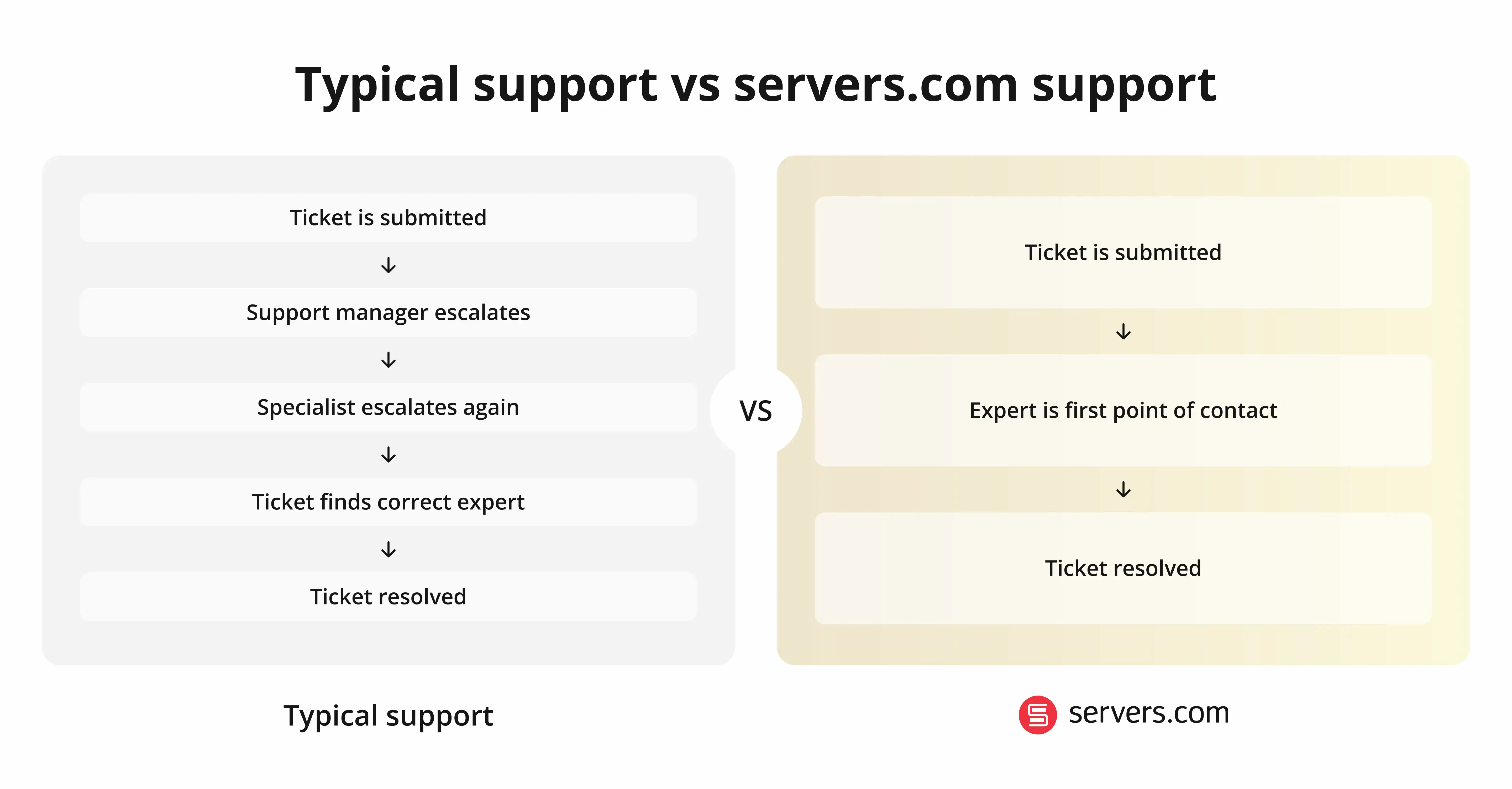
How we achieve this
This level of support isn’t achieved overnight. We keep ourselves accountable through rigorous processes that ensure we never fall below the standards that customers deserve from their infrastructure support teams.
“It’s exactly why our level of customer support is built on three key foundations” illustrates Alexandra, who is instrumental in shaping our support model: “our employee training programme, our internal quality control, and how we invest in our people.”
Our employee training programme
In an industry with steep learning curves, a good training program can make the difference between seamless support and frustrated customers.
“Every day is a school day at servers.com” says Alexandra. “Whether an IaaS support engineer has one year’s experience or ten, every colleague that starts at servers.com goes through a two-month training programme, regardless of any previous experience. And if the business requires (or if a colleague wants to continue their personal development) there are also higher levels of training which can take up to two years to complete.”
Making sure everyone starts in the servers.com support team at the same level mitigates any risks of knowledge gaps, assumption making, or miscommunication. Alexandra understands how even small slip-ups - often the result of teams not being fully aligned - can quickly escalate when infrastructure is involved:
“Our customers rely on their infrastructure to keep their businesses running, and even small mistakes can have a real impact. That’s why we don’t rush people into live environments; engineers only start working directly with customers once they’ve completed closely supervised work and proven they’re ready. Mistakes happen - we’re all human - but we do everything we can to reduce risk, with no assumptions made about what someone should already know, no matter their background.”
Our internal quality control
Our quality control is all managed via an internal portal where we record each ticket, its support journey, feedback received from the customer, and any immediate attention it needs.
“To ensure quality across our customer support, we follow our ‘four eyes’ principle. Simply put, every ticket and customer request is reviewed and audited by not one but two servers.com support engineers. This process remains in place even after our engineers are fully trained and working independently, providing an extra layer of assurance that nothing is missed and standards stay consistently high.”
Our people and culture
Support roles worldwide have notoriously high turnover rates. According to Insignia Resources, the average turnover rate for tech support roles is 30-40%, compared to the industry average of 13.2%. The study puts this down to harsh learning curves and needing to solve difficult problems that many aren’t equipped enough to tackle.
This isn’t the case at servers.com, thanks to Alexandra and her team’s investment in people, not just processes.
“Across every service and industry, there are skills you can’t teach, but that are earned through long-term commitment to a specific area. IaaS support is one of the clearest examples of this, where consistency and deep, hands-on experience make a real difference.
“Because we invest in our people through training, development, and creating career paths within our different teams, our support team stays with us far longer than the industry average. The numbers speak for themselves: we have 26 engineers who have been working at servers.com for more than three years, with a further 12 who are approaching their two-year mark.
“As such, our customers aren’t speaking via a support line with someone here today and gone tomorrow. Rather, they’re in the hands of an engineer who has an incredibly deep understanding of our solutions, as well as the knowledge of the industry in which you operate. They know it inside out, because our timelines are in years, not months.”
What this looks like in the real world
That difference becomes clearer when looking at how customers experience support in practice.
Customers such as Nitrado, a private game servers provider who supply the servers for games like DayZ, Minecraft and ARK: Survival Ascended: Nitrado partnered with servers.com in 2020, after a huge growth in their business prompted a much-needed hardware refresh in order to stay competitive. Felix Oechsler, CTO of Nitrado, comments:
“Our excellent support at Nitrado is what sets us apart and it’s also what sets servers.com apart from other dedicated hosting providers. Since day one of our partnership, we haven’t dealt with faceless, corporate figures who disappear as soon as the deal is done. We’ve had a very down-to-earth, human relationship with the servers.com team and the people we met in that very first meeting are still the people we deal with today.”
It’s the launch of a game in particular that demands a level of hands-on support so critical that the quality of that support alone can make or break the release. The reality is that no studio truly knows how many players will turn up on day one, so having experienced engineers on hand ready to react, scale, and troubleshoot in real time is essential.
“This approach to customer support is a big reason why we prioritize servers.com over other hosting providers.” As Felix explains: “They’re also our engineers’ preferred provider because they find it so easy to work with them. All of us appreciate the human-led support that servers.com provides.”