Network
All too often, infrastructure performance is treated as a technicality, and only an issue for engineering teams to manage once an application is in production. But as the foundation for application performance, infrastructure should be considered as a business-wide priority.
Latency directly impacts user experience, throughput dictates traffic handling capacity, and predictability mitigates risk. When performance degrades, symptoms show up at the application layer, but the root cause usually sits at the hardware level.
This is why many businesses eventually reach a point where they start questioning their infrastructure strategies. Hyperscale cloud costs keep rising without meaningful performance gains, and demand spikes become harder to tolerate as workloads that should theoretically scale smoothly, don’t.
At this point, it’s not enough to just source ‘faster’ servers. You’ll need to understand what drives infrastructure performance, when to re-architect, and the criteria that matter most when comparing infrastructure-as-a-service (IaaS) providers.
At a basic level, IaaS performance is driven by four measurable factors: compute, memory, storage and network. These are the building blocks most infrastructure buyers focus on first. But in modern production environments, raw specifications alone only tell part of the story.
Consistent performance under sustained load matters just as much, and this is where architectural design choices start to matter. Bare metal environments deliver more reliable performance compared to shared public cloud setups. That’s because single-tenant architectures eliminate virtualization overhead and give teams full hardware and network control. By contrast, virtualized architectures trade some of that predictability for rapid elasticity.
Whilst virtualization has matured to a point where performance loss is less of a concern than it once was, virtualized environments are still vulnerable to misconfigurations. One study that ran approximately 15,600 measurements across bare metal and virtual machines (VMs) observed performance losses of up to 72% in the case of non-optimized virtualization software. When performance availability measurements were taken across bare metal and virtualized environments, results showed that bare metal performance remained consistently stable across all components, whereas virtualization produced unpredictable results.
In other words, performance stability in virtualized environments is fragile – especially considering most businesses (some reports suggest up to 98%) do have misconfigurations in their cloud environments. Achieving ‘ideal’ results in these environments is the exception rather than the rule.
Achieving exceptional performance starts with purpose-designed architectures. For some teams, that might mean shifting to a bare metal-first approach, for others the sweet spot lies in a hybrid infrastructure strategy, combining the elasticity of virtualized compute with the performance stability of bare metal cloud.
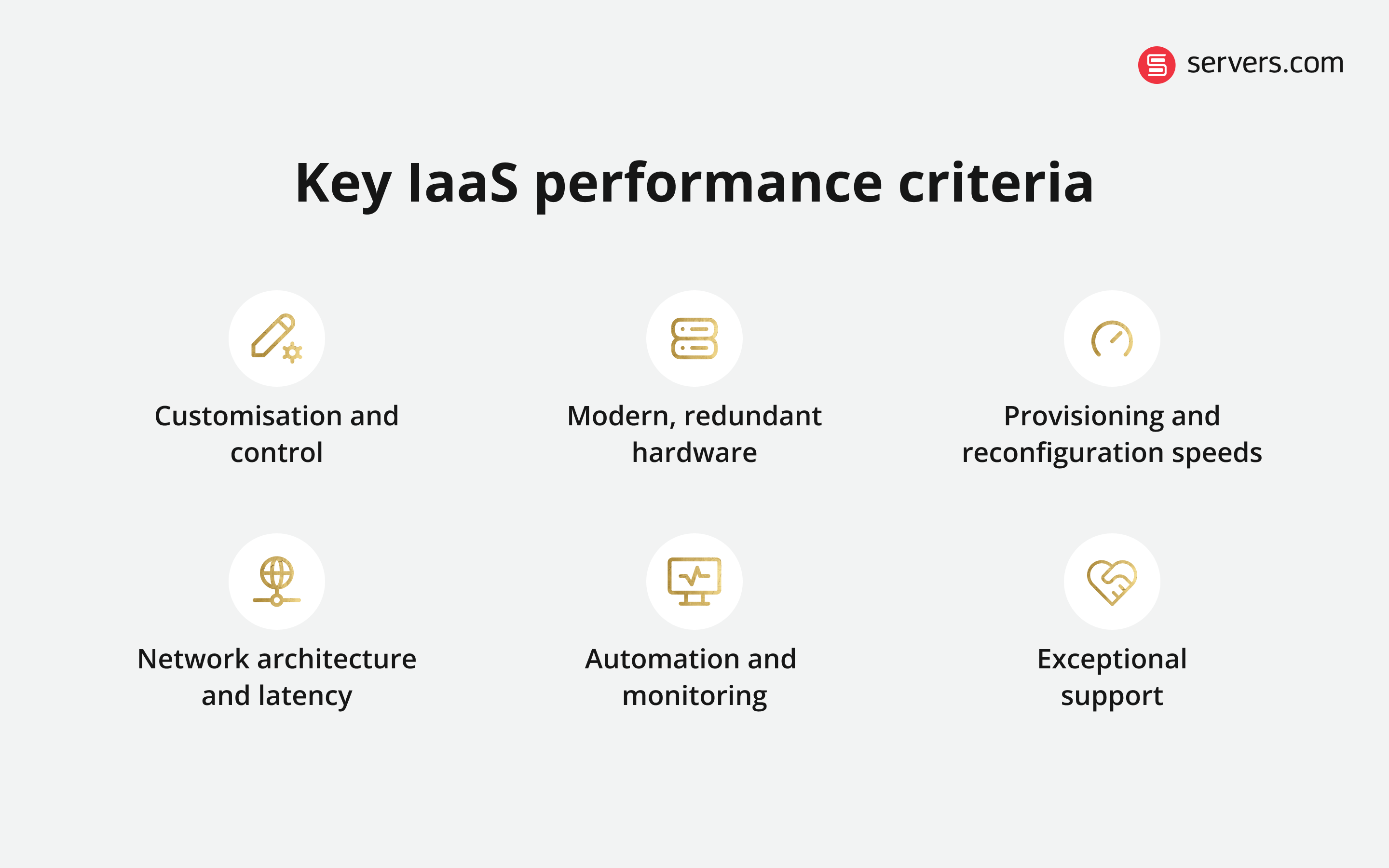
Whichever architecture you choose, finding the right bare metal cloud partners to add into your mix is the first step. If you’re unsure what to look for, the following criteria will help you to identify providers of high-performance computing infrastructure.
Customization is a fundamental performance foundation. Fixed instance types and standardized environments make it easy to get started, but they also force workloads into predefined boxes. Over time, that mismatch between workload needs and infrastructure design becomes a performance bottleneck.
With servers.com, custom dedicated servers are designed around bespoke configurations, and the following components are all individually configurable:
Operating system (OS) type and installation method
RAM capacity
Disk type, quantity, RAID configuration and partitioning
Number of network interfaces and link aggregation
This flexibility enables teams to fine tune their hardware for specific performance goals. It’s precisely what enabled real-time video streaming platform, Ceeblue, to create a high-performance infrastructure foundation for their end-to-end transcoding, delivery and real-time origin services:
“servers.com knows our industry well and works closely with our team to tailor offerings that make sense, case by case. We’ve collaborated to co-develop all the hardware that we currently deploy,” said Jonas Blötz, VP of Engineering at Ceeblue. “servers.com provides us with the latest and greatest in hardware. Having access to a wide range of devices and components allows us to continually improve the performance and efficiency of our service.”
Poor hardware quality degrades performance. Many IaaS providers advertise similar specifications, but not all hardware is sourced, deployed, or maintained to the same standard. Some providers may rely on mixed-generation components or loosely assembled systems, which can lead to instability and performance issues over time.
“To ensure all hardware is of the highest standard, servers.com maintains strong supply relationships with Dell and Supermicro and deploys latest-generation AMD and Intel CPUs,” said Evgenii Shabanov, Head of Product at servers.com.
“As well as selecting performant hardware, redundancy is also built in at every level. Each rack is powered by two independent power sources, reducing the risk any single failure has on availability or performance.”
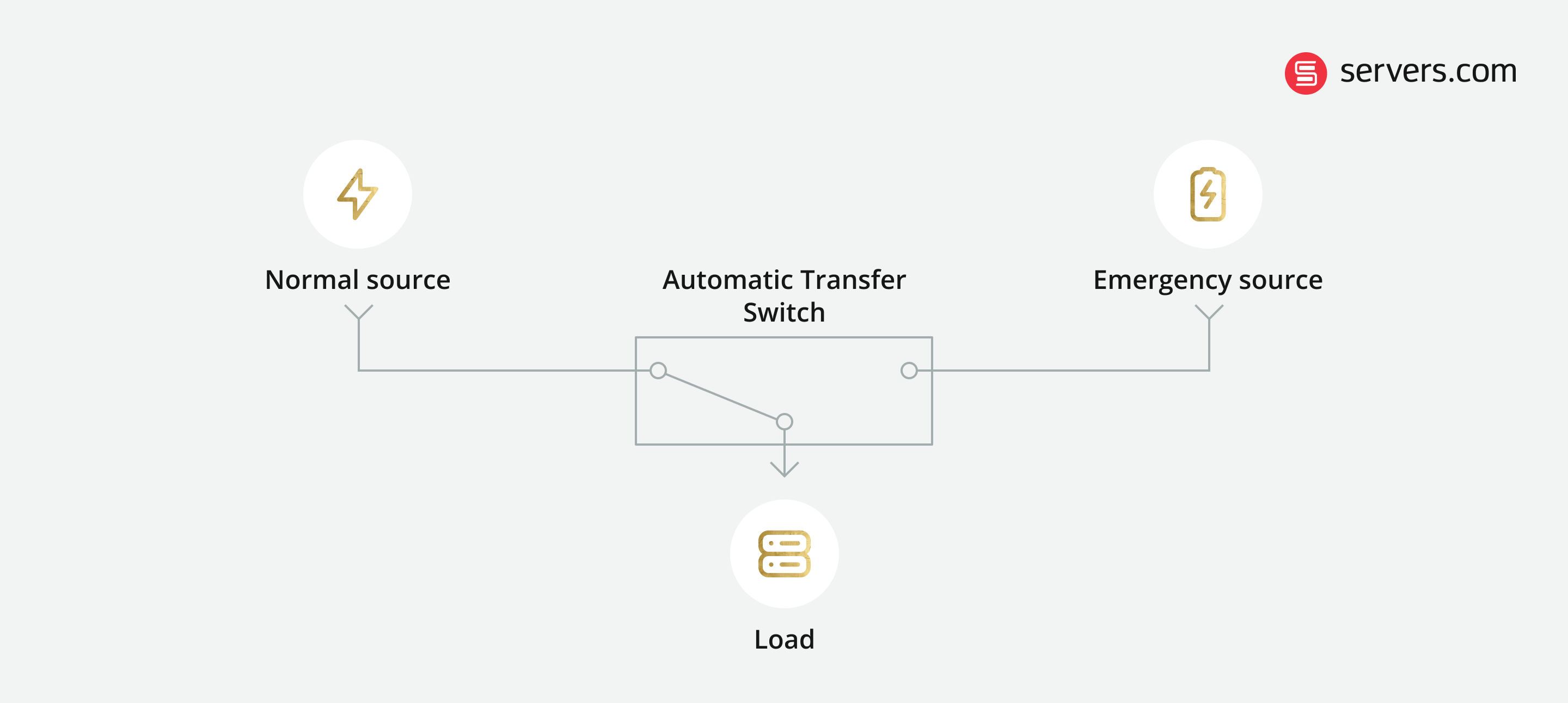
For servers with a single power supply unit (PSU), an automatic transfer switch (ATS) switches power to the backup source in the event of power failure, ensuring no service interruptions.

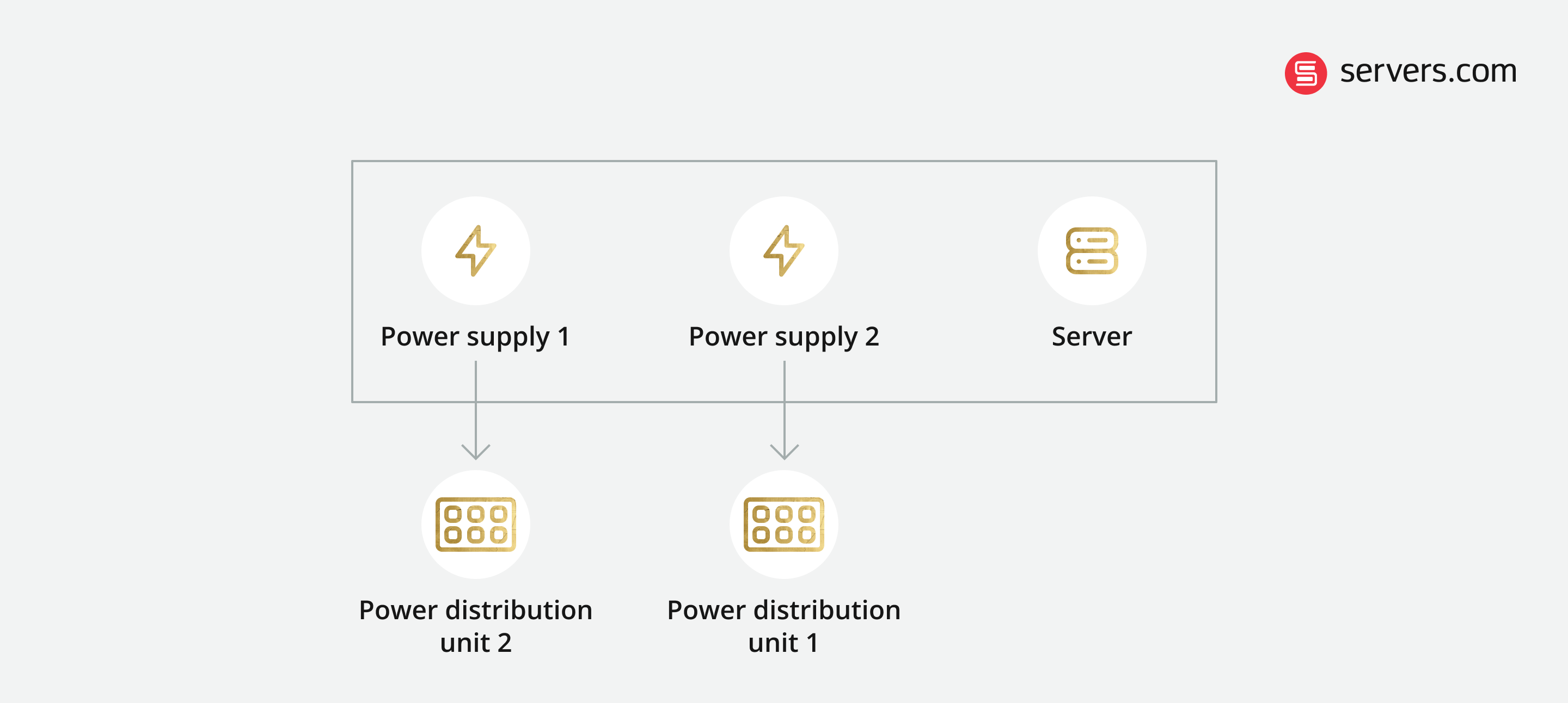
For servers with dual power supply units, each PSU is connected to a separate power distribution unit (PDU) in the server rack.
This added layer of stability and redundancy is a huge asset to organizations operating in highly latency-sensitive industries. When programmatic advertising technology platform, GeoSpot Media, first met servers.com they were looking for a scalable infrastructure with high uptime and redundancy to minimize downtime risk amidst a rapid growth in queries per second (QPS). Founder and CEO, Rishi Agarwal discusses the performance improvements GeoSpot media were able to achieve after partnering with servers.com:
“Since migrating, we’ve seen average response times improve by around 30% across major markets, and our fill rates have increased by 25% thanks to more stable and faster bidding. With servers.com, we’re able to maintain 99.99% uptime, which has helped boost publisher retention by around 20%. That stability has been transformative for our business and our partners.”
“servers.com provides us with the latest and greatest in hardware. Having access to a wide range of devices and components allows us to continually improve the performance and efficiency of our service.”
How quickly your IaaS provider can spin up new servers (including bulk deployments and reconfigurations) is critical. But speed alone isn’t enough, and rapid deployment must be paired with configuration flexibility.
Efficient and predictable provisioning allows businesses to plan capacity around real demand, scale without friction, and avoid service interruptions or downtime. However, if that hardware cannot be properly customized (CPU, RAM, storage, networking), fast provisioning simply turns into fast inefficiency.
Without flexible configurations, businesses risk overprovisioning, underutilizing their resources, and unnecessary costs, with performance losses and wasted capacity the inevitable result. Real value lies in striking the right balance: the ability to scale quickly when needed, while retaining full control over how the infrastructure is configured and optimized.
With servers.com you can provision a bare metal server in 15 minutes or less. Large fleets and bulk operating system (OS) reinstallations are also fast and repeatable, allowing customers to repurpose machines for evolving workloads without unnecessary downtime. And, most importantly, we combine efficient provisioning with flexibility – enabling our customers to configure their hardware for their specific use cases and optimize performance outcomes.
“With servers.com, we’re able to maintain 99.99% uptime, which has helped boost publisher retention by around 20%.”
Network performance and network architecture directly impact platform performance in the following ways:
| Network performance parameters | Performance impact |
|---|---|
| Bandwidth | High bandwidth networks support large data transfer rates and prevent bottlenecks. |
| Latency | Low latency networks minimize delay between sending and receiving data – critical for real-time applications. |
| Throughput | A network with efficient throughput reduces packet loss and maximizes the amount of useful data delivered. |
| Network architecture parameters | Performance impact |
|---|---|
| Scalability | Scalable networks grow to accommodate more users, devices and traffic as demand increases. |
| Availability | High availability networks offer redundant links, devices and paths to avoid single points of failure. |
| Security | Secure networks employ encryption and firewalls without degrading speed or latency. |
| Traffic management | Load balancing, traffic shaping and routing optimization ensures traffic is managed intelligently. |
servers.com operates a high-availability, redundant network architecture with servers connected to three physically isolated networks: the public network, the private network (servers.com’s Global Private Network) and an out-of-band management network.
The public network: The public network is accessible over the internet to a wide range of users. It’s designed for external traffic (e.g. interacting with clients, partners and customers).
The private network: Our Global Private Network (GPN) is isolated from the public internet and restricts access to internal systems only. It’s designed for secure, isolated communication between servers.
Out-of-band management network: Our OOB management network is a dedicated network that allows for access and remote server management (e.g. via iDRAC) even if the public or private networks are unavailable.
This multi-network design was a key consideration for multi-screen video delivery platform, More Screens: “The availability of the hardware, in combination with the delivery capacity of each server with servers.com was an important factor for us. Providing stable and redundant 20Gbit/s connections per server, servers.com has enabled us to deliver hundreds of Gbit/s of stable streaming service at peak times,” shared CTO, Haris Zukanović.
In addition to providing a multi-network architecture, and to accommodate customers’ infrastructure scaling needs, servers.com’s private and public networks are both L3 Fabrics. These are IP-based network architectures that mobilize leaf-spine topologies and efficient routing protocols to offer highly scalable network performance.
To ensure security, servers.com customers can also create environments isolated from the public network using L2 segments. Network segmentation (or subnetting) increases security within the network by allowing a single client to assign servers with different roles to different segments (e.g., a server hosting a public website can be isolated from servers running a CRM).
To optimize traffic management, our network-based firewall blocks traffic that isn't explicitly permitted. In addition, our load balancing service distributes traffic across multiple servers, improving performance efficiency by demanding less from each server.
Consistent performance depends on visibility, which is reliant on monitoring and automation. Automation reduces human error and enables rapid, repeatable actions at scale while monitoring ensures issues are detected early, before they can severely impact performance.
servers.com customers can manage their hardware through a public API or infrastructure-as-code tools like Terraform or Ansible. These tools enable automation and integration with existing workflows which is particularly valuable for customers managing large environments or frequent changes.
At the hardware level, out-of-band management systems provide deep monitoring and remote management capabilities, including immediate visibility into hardware failures. Managed PDU access also allows power reboots directly from the control panel when needed.
“servers.com has enabled us to deliver hundreds of Gbit/s of stable streaming service at peak times.”
Even the best infrastructure will eventually encounter issues. And when that happens, support quality becomes a performance factor. Without exceptional infrastructure hosting support, minor incidents can escalate into latency spikes, or prolonged service degradation.
servers.com provides 24/7/365 human support, with dedicated account managers and solution architects available to assist with both day-to-day operations and long-term performance optimization. Importantly, support teams are reachable in minutes and work closely with customers as part of their own teams to build performant architectures in the first instance and resolve any issues that do occur before they impact end users.
Exceptional IaaS performance comes from smart architectural choices. A direct reflection of this can be observed in the way cloud use is changing. Seeking greater performance stability and customization, more businesses are incorporating bare metal into their mix.
When partnered with the right bare metal providers, dedicated compute becomes a performance anchor, supporting latency-sensitive, mission-critical workloads. And with deep customization, global networking, and hands-on support, servers.com’s bare metal solutions provide this anchor for performance-sensitive businesses operating at scale.
Whether you’re thinking of incorporating bare metal into your stack for the first time, or looking to diversify your existing mix, speak to our experts to discuss your use case.

Frances is proficient in taking complex information and turning it into engaging, digestible content that readers can enjoy. Whether it's a detailed report or a point-of-view piece, she loves using language to inform, entertain and provide value to readers.