It’s Wednesday afternoon and your users are reporting system-wide lag and errors. You contact your infrastructure provider’s support channel, only to be placed in a ticket queue, met with a bot triage loop and bracing yourself for the long wait ahead.
Whether it’s a regional outage or performance hiccups during a product launch, the lack of timely and robust support is something most organizations face at one point or other.
But when every extra minute you’re left waiting to speak to an expert means your platform is performing poorly (or not performing at all), it’s more than time at stake; it’s revenue and reputation. In fact, the average cost of IT downtime is approximately $5600 per minute.
It’s a universal fact that technology will fail sometimes, but the lasting damage is rarely about that single botched disk or DNS error; it’s almost always about support failures.
The infrastructure hosting support gap
Standard infrastructure as a service (IaaS) support models tend to break in predictable ways: bot triage loops slow down incident responses, opaque escalations leave customers in the dark, and vendor silos bounce clients between queue categories.
Often, those very same clients are then met by after-hours or weekend closures that leave them completely stranded when they most need help. Narrow that focus to the market giants and there’s an additional, more insipid, problem at play: unequal prioritization of accounts.
One of the most common misconceptions around hyperscale cloud providers is that they must, by default, come with comprehensive support. But, hyperscaler support isn’t rationed equally and only the biggest billing users (or those willing to pay for additional support tiers) get adequate care. For the rest, ‘break-fix only’ is standard, and it can take weeks to get a response after raising a ticket - no matter how significant an issue is to your business.
The net effect is that your incidents last longer, your launches carry more risk, and your team shoulders the very work that your hosting provider should absorb. As one Global Director of Technology at a leading iGaming platform told servers.com:
“You rarely get proper attention for things that matter to your business but are not critical for your [hyperscale] cloud provider. For example, a bandwidth interconnection between two regions is not important for them just because it's causing some delay. Even if this delay is causing you a loss of revenue, you are not going to get traction on understanding what happened and get the fix (or even a hot fix) for the problem.”
In short, hosting provider support teams simply do not serve as an extension of your team: this is where the problem lies.
When lazy support becomes a big problem
For businesses that haven’t yet experienced the fallout after navigating infrastructure challenges without access to adequate support, it’s easy to think of it as just another cost center. But this is one of the biggest infrastructure hosting mistakes that businesses make.
When infrastructure support can’t be relied upon to get issues fixed quickly, it leads to a domino effect. For example, if you’re a business launching a new platform to market for the first time, unresolved incidents could delay your entire launch. If you’re forced to spin up more servers to compensate, there’s also additional spend incurred.
Similarly, if you have an established platform that goes down, being unable to fix the problem quickly leads to customer dissatisfaction, engineering drag (as your users’ own support tickets accumulate) and a negative hit to user retention. And if your issue concerns security, there’s also legal and compliance-based risk to consider, including potential fines and penalties. Quickly, what began as a support ticket, starts to hit your bottom line.
How to calculate the total costs of an incident
But what’s the real cost of a poorly supported incident? Let’s consider an example. Imagine you’re a live streaming platform. You suffered a 45-minute outage during your latest live sports event. Your revenue is driven by advertising and pay-per-view subscriptions and there’s a heavy social fallout when streams fail.
Let’s plug in some numbers to see how much this period of downtime might cost you:
Say your event generates an average hourly revenue of $200,000 and you suffer an effective outage of 0.75 hours. That’s $150,000 in lost revenue. If it takes 15 engineers and three managers to resolve the incident and they’re billed at $120 and $160 per hour respectively, that’s another $5700 on incident handling. The outage also caused a heavy social fallout, so your engineers spend an additional 60 hours on post-incident follow-ups costing $7200.
You owe $90,000 in customer refunds and credits, involving 120 hours of extra support staffing at $40/hour to manage, totaling $94,800 on customer remediation. You also owe your partner advertisers $30,000 in make-goods for lost impressions, spent $4200 on compliance and reporting (30 hours at $140/hour), and signed up for two months of excess compute capacity costing $40,000.
Lastly, you predict that you will incur $144,000 in probable churn (based on $12/month ARPA, an estimate churn delta attributable to the incident of 0.5 % per month and six-month average remaining paid term).
The total cost of the incident is $475,900.
Whilst these numbers serve only as an example, it demonstrates how quickly costs spiral when an incident goes unresolved (even for just 45 minutes) and the additional cost fallout that follows even after an incident is resolved.
If you’ve not conducted this type of exercise before it’s well worth plugging in your own numbers to see how much a similar outage could cost your business.
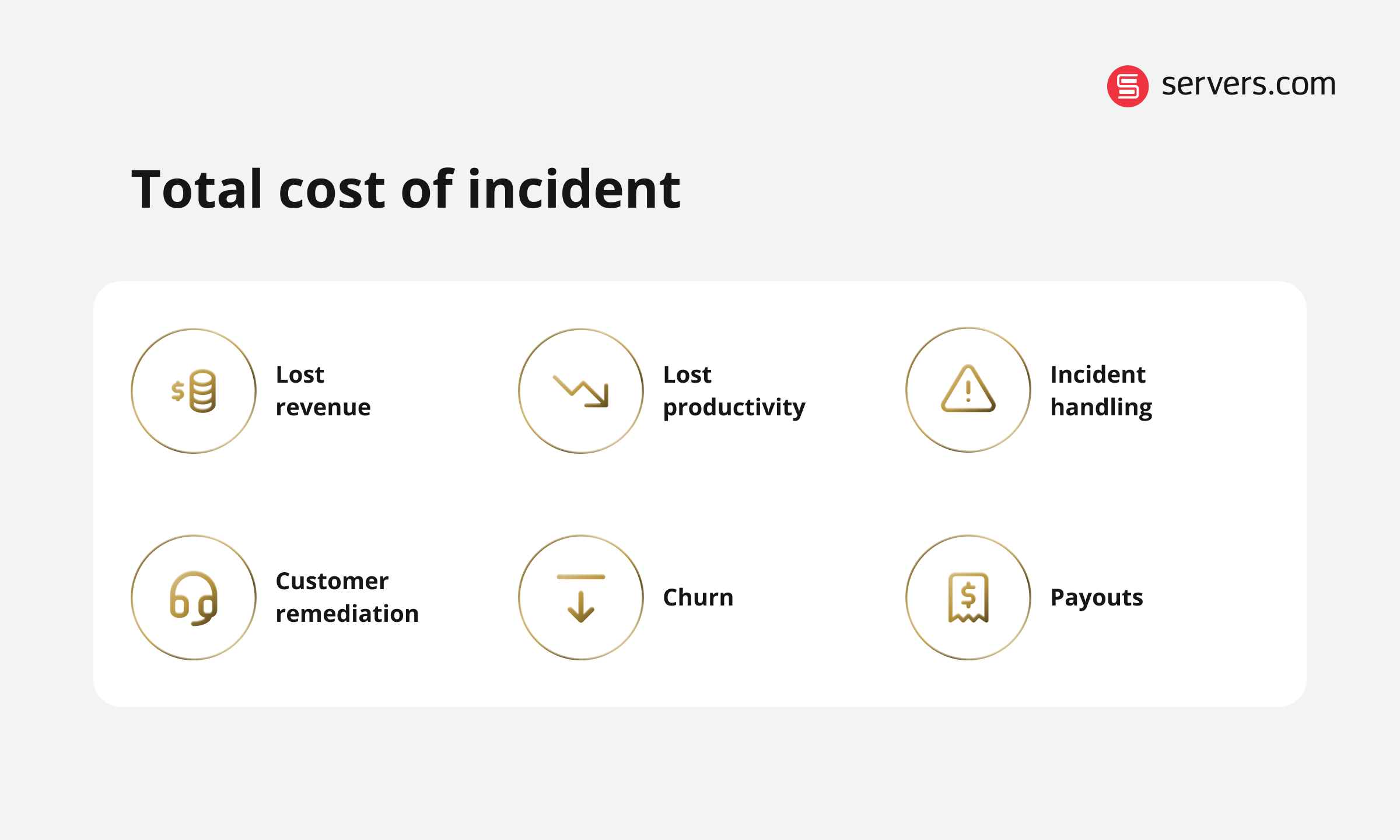
To work out the total cost of an unresolved incident, calculate the sum of the following:
- Revenue lost to the incident
Lost revenue = revenue per hour x business hours down
- Productivity lost to the incident
Lost productivity = number of affected staff x loaded rate per hour x hours disrupted
- Cost of incident handling
Incident handling = role involved in incident handling x rate per hour x hours
- Cost of customer remediation
Customer remediation = value of refunds/ credits + extra support hours x support rate
- Costs attributable to churn
Impacted paying customers x average revenue per user (ARPA) x churn rate x remaining contract months
- Any additional lump sum payouts incurred as a direct result of the incident