Video streaming alone is a $674 billion industry, with music streaming valued at close to $50 billion and cloud communications at close to $24 billion in 2026. It means the infrastructure that underpins these workloads has become a mission-critical business priority. Viewers today expect instant startup and consistent quality, especially during live moments when the stakes are highest. As a result, low latency streaming targets map directly to engagement and revenue.
But infrastructure problems rarely show up all at once. They surface gradually as your audience grows and your delivery model gets more complex. Most teams hit the same set of pressures in three connected areas: keeping performance stable under pressure, facilitating growth without disruptive re-architecture, and controlling cost, risk, and governance at scale.
In this guide we’ll walk you through common streaming infrastructure challenges and practical steps you can take to regain control over your streaming stack.
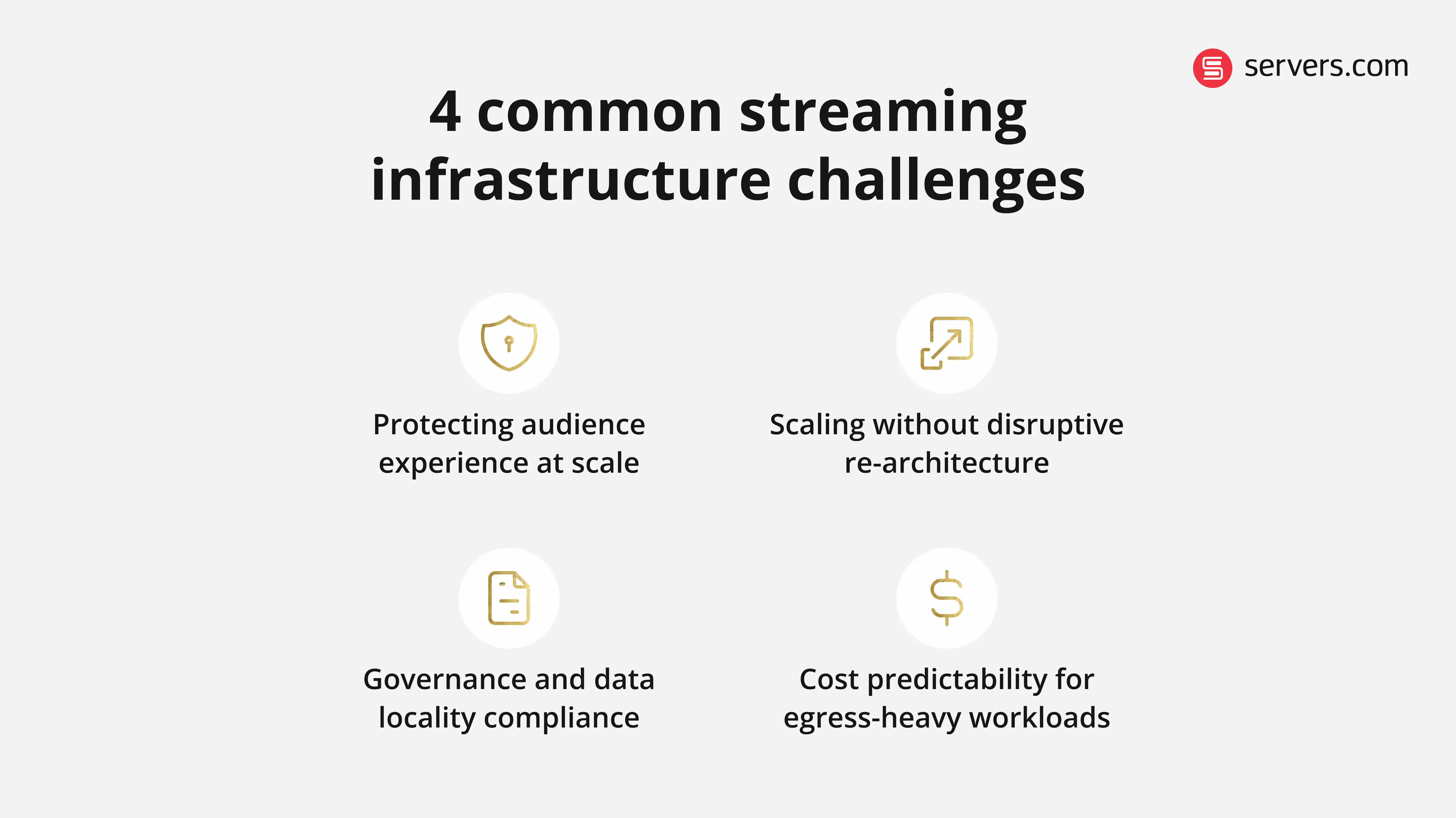
1. Protecting audience experience at scale
Performance strain is often the first signal that something in the streaming stack is starting to break down. As audiences grow and demand becomes more sustained, you may notice latency spikes or inconsistent playback quality - especially during peak events or periods of high concurrency. These issues don’t always stem from a lack of raw capacity but tend to emerge when sustained throughput and concurrency expose architectural flaws.
This is common in hyperscale cloud environments where platforms technically scale, but often at the expense of performance consistency. Because server resources are shared with other platforms, contention can occur, leading to performance becoming less consistent. At this point, your confidence in how delivery behaves under pressure starts to erode and, over time, this creates additional operational strain. You may begin relying on manual interventions, reactive workarounds, or last-minute adjustments during critical moments.
Streaming platforms need delivery performance that remains consistent as demand scales, without increasing operational fragility or relying on reactive fixes when it matters most. This is where the choice between bare metal vs hyperscale cloud for streaming performance becomes an important consideration.
The solution: placing performance-critical workloads on dedicated servers for streaming. Single-tenant infrastructure designed for latency-sensitive, throughput-heavy delivery with exclusive access to compute, memory, and network resources reduces performance variability and eliminates contention from neighboring workloads. Combined with high-quality, modern hardware and infrastructure close to audience hubs, performance then stabilizes.
2. Scaling and evolving streaming platforms without disruptive re-architecture
Once you start scaling out your platform you may realize that it’s more difficult to modify your infrastructure than initially expected. If you built your platform around proprietary hyperscale cloud products and services, you may have inadvertently become locked into those solutions. Change can feel near impossible without significant risk and operational disruption - even if these existing models no longer align with how your business operates.
Treating all streaming workloads the same exacerbates the problem. When workloads with different characteristics and requirements are forced onto the same infrastructure, it creates unnecessary coupling and complexity, along with reduced flexibility to adapt as requirements change. In some cases, modernizing or scaling components requires total re-architecture.
The solution: a hybrid workload placement strategy with long-term, predictable workloads running on dedicated infrastructure optimized for stability, and short-term workloads or experimental components running on on-demand compute. This approach supports phased evolution and provides additional redundancy. Teams can modernize and scale without forcing wholesale re-architecture or operational upheaval, and infrastructure change becomes incremental and intentional, rather than a high-risk all-or-nothing decision.
3. Cost predictability for egress-heavy workloads
As streaming platforms mature, infrastructure costs in usage-based environments stop behaving linearly. This is especially true for egress-heavy workloads, where any change in delivery patterns, concurrency, or audience behavior can quickly drive up spend.
You may struggle to forecast costs as traffic becomes more sustained. Delivery costs can increase unpredictably, making it hard to forecast spend. Often you won’t know how much a demand surge has cost you until after the fact. Planning, defending budgets, or making confident decisions about scaling your business or trying new formats becomes challenging.
The solution: moving performance-critical, egress-heavy workloads onto dedicated environments with transparent billing and high bandwidth models. Clear cost behavior makes it easier to calculate the infrastructure cost of your streaming servers and to forecast (and defend) these costs at scale. With predictable pricing structures, teams can plan growth with confidence rather than reacting to cost surprises after the fact.