Back
Back

What your cloud bill isn’t telling you about adtech ROI

What your cloud bill isn’t telling you about adtech ROI

In adtech, real-time bidding systems live and die by tiny time budgets. With no more than 120ms often separating a winning bid from a lost one, success is achieved at the micro level. But all too often with hyperscale cloud, your bill only shows the big line items – compute, data transfer, storage – without ever explaining how that spend maps back to the real outcomes that drive your business.

Lost bids mean lost revenue, so understanding why your performance isn’t winning on every bid is crucial for your return on investment. The challenge is that most infrastructure reporting tells you what you paid for, not what that spend did. It doesn’t show where time was lost, where capacity was wasted, or where costs quietly crept in just to keep systems stable.

How infrastructure choices shape adtech ROI

To get a clearer picture of ROI, adtech teams need to look past total spend and focus on cost-per-bid - the combined effect of performance consistency, capacity efficiency, and data movement under real auction pressure. That’s where infrastructure behavior starts to matter, and where the biggest hidden costs begin to surface.

In practice, there are three infrastructure factors that tend to have the biggest impact on cost-per-bid:

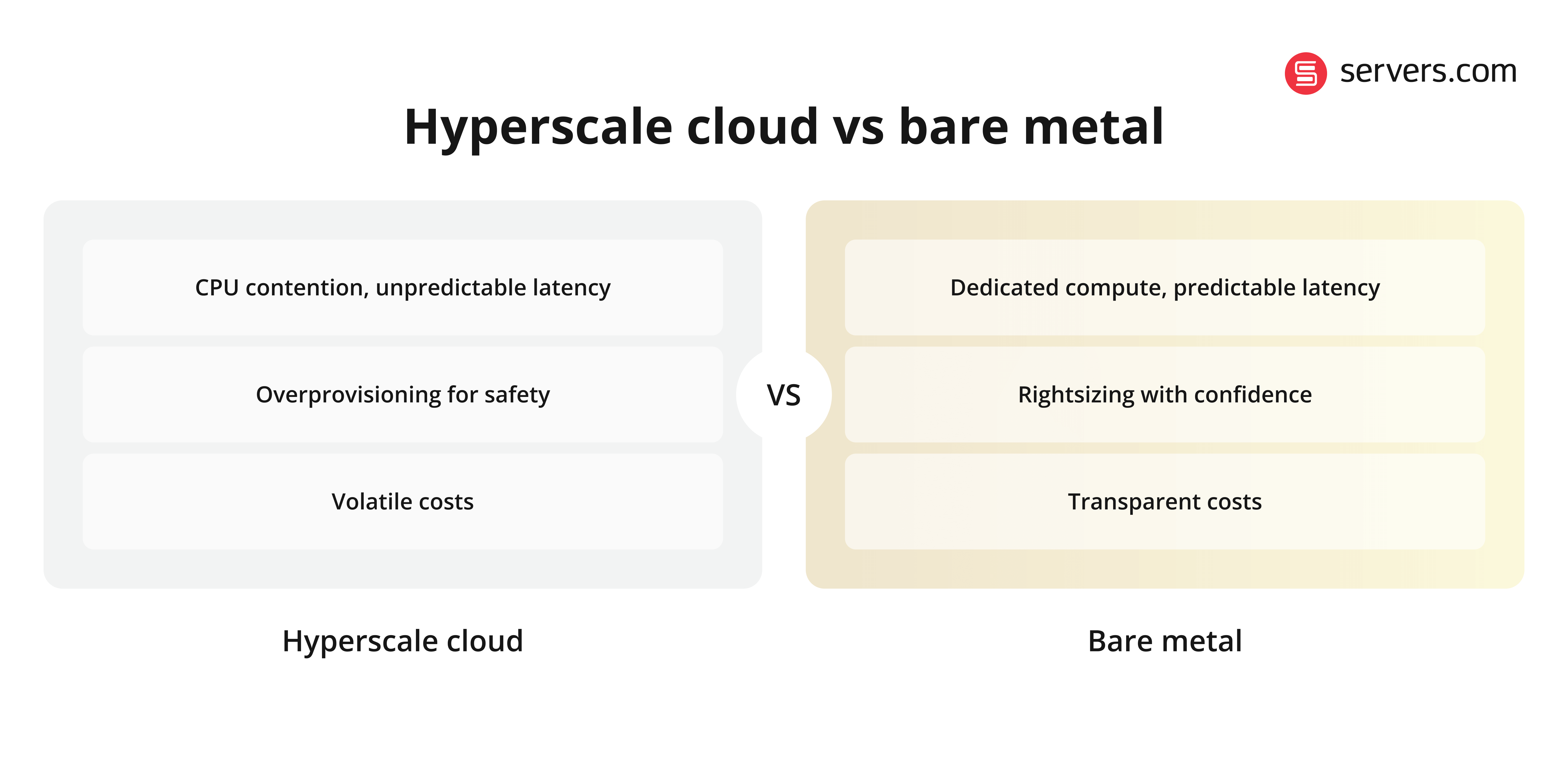
CPU contention and its impact on latency

In virtualized environments, compute resources are shared. That means your bid often waits in line with ‘noisy neighbors’ - other virtual machines (VMs) on the same physical server - for CPU and network time. This waiting shows up as latency, and when auctions are won and lost in milliseconds, shared resources become a direct driver of lost revenue.

Over-provisioning for safety

The public cloud makes it tempting to size for ‘what if?’ moments - traffic spikes, sudden surges, or worst-case scenarios. But that extra headroom doesn’t come free. You end up paying for capacity you rarely use, and that cost gets buried in monthly bills without ever showing up in the real outcomes that matter. The data from over 200 adtech stacks is clear: compute (VM and container) came to a median share of 42% of the cloud bill - 25% of that was wasted.

‘Cloudy’ network and egress costs

Every data exchange - whether that be partners, analytics systems, or reporting platforms - can trigger charges in cloud platforms. When you’re moving terabytes of traffic every month, these fees add up quickly and unpredictably. They rarely look big on a line item, but they matter when you’re trying to understand what each bid actually costs you.

This unpredictability also makes financial forecasting harder. CFOs struggle to model the volatility of cloud costs, egress-driven spikes and regional pricing differences. Tracking spend becomes a job in itself, which helps to explain why the FinOps (Financial Operations) industry is currently booming.

Put these three behaviors together and it becomes clear why cloud infrastructure costs leak in ways that are easy to miss. Margins are already thin. A few extra milliseconds of latency can mean fewer auction wins, and that difference compounds every time your platform lives under load.


bare metal vs cloud for adtech

How bare metal can plug the leaks

For adtech platforms, bare metal is often chosen for its performance and level of control. Dedicated by design, it provides exclusive access to compute, memory, storage, and network resources, with the flexibility to tailor hardware configurations to your requirements.

That stable foundation makes infrastructure behavior easier to understand. When performance is consistent, teams can more closely align capacity, cost, and tuning decisions with the realities of real-time bidding.

Dedicated compute, predictable latency

Bare metal isn’t shared. With no VMs splitting up the underlying hardware, there are no noisy neighbours, and no surprise latency caused by someone else’s workload. Bids arrive, are processed, and leave on infrastructure that behaves the same way at 3am as it does during peak traffic.

Right-sizing without over-insurance

Because performance is predictable, teams don’t need to design around worst-case contention. Infrastructure can be sized closer to real demand, rather than padded with permanent excess headroom “just in case.” That reduces waste without forcing teams to accept more risk.

This doesn’t mean giving up elasticity entirely. Many teams pair bare metal with hyperscale cloud in hybrid setups, using cloud capacity for genuine spikes while keeping steady, revenue-critical workloads on predictable infrastructure that doesn’t drift under pressure.

Transparent costs, no unwanted surprises

Provisioning the right amount of dedicated infrastructure means you’re no longer paying for capacity you don’t use. Costs are clearer, pricing aligns with the hardware you actually run, and scaling happens on your terms. That makes it far easier to tie infrastructure decisions back to cost-per-bid with confidence.

Instead of reverse-engineering cloud invoices, teams can focus on unit economics, forecasting, and long-term margin optimisation — with known infrastructure costs underpinning those models.

Migrating to bare metal doesn’t mean abandoning cloud strengths

The reality is that adtech infrastructure is rarely an either-or decision. Many teams see the best results by combining both approaches.

Still, that first step away from 100% cloud dependency can feel daunting. Not because the destination looks wrong, but because the journey feels risky. It’s natural to hesitate before making changes to systems that directly touch revenue.

In practice, moving parts of an adtech stack onto bare metal is rarely a big-bang event. It’s incremental, measured, and designed to avoid disruption. Teams run workloads in parallel, shadow traffic, and compare outcomes before committing. Evidence comes first, confidence follows.

Crucially, this doesn’t mean walking away from the cloud or pretending it has no place. Many adtech teams continue to rely on cloud platforms for exactly what they’re good at: fast experimentation, model training, short-lived environments, and genuine burst or seasonal demand.

Where bare metal tends to take over is at the core of the business. Real-time bidding, high-throughput decisioning, and data-dense pipelines benefit from infrastructure that behaves predictably under pressure. When every millisecond affects ROI, having a stable foundation changes how confidently teams can tune performance and cost.

Seen this way, migration isn’t about abandoning cloud, but about separating yourself from its drawbacks while retaining its benefits. Bare metal lowers the cost of certainty for revenue-critical paths, while cloud preserves the value of optionality. Together, they give teams clearer control over where risk, performance, and spend actually belong.

Author: Nathan Jollands

Nathan Jollands, Content Writer

Nathan studied Creative Writing at Bath Spa University, including a six-month Erasmus scheme at Stockholm University in 2020. Outside of work, Nathan is both a film buff and car enthusiast.

Related articles