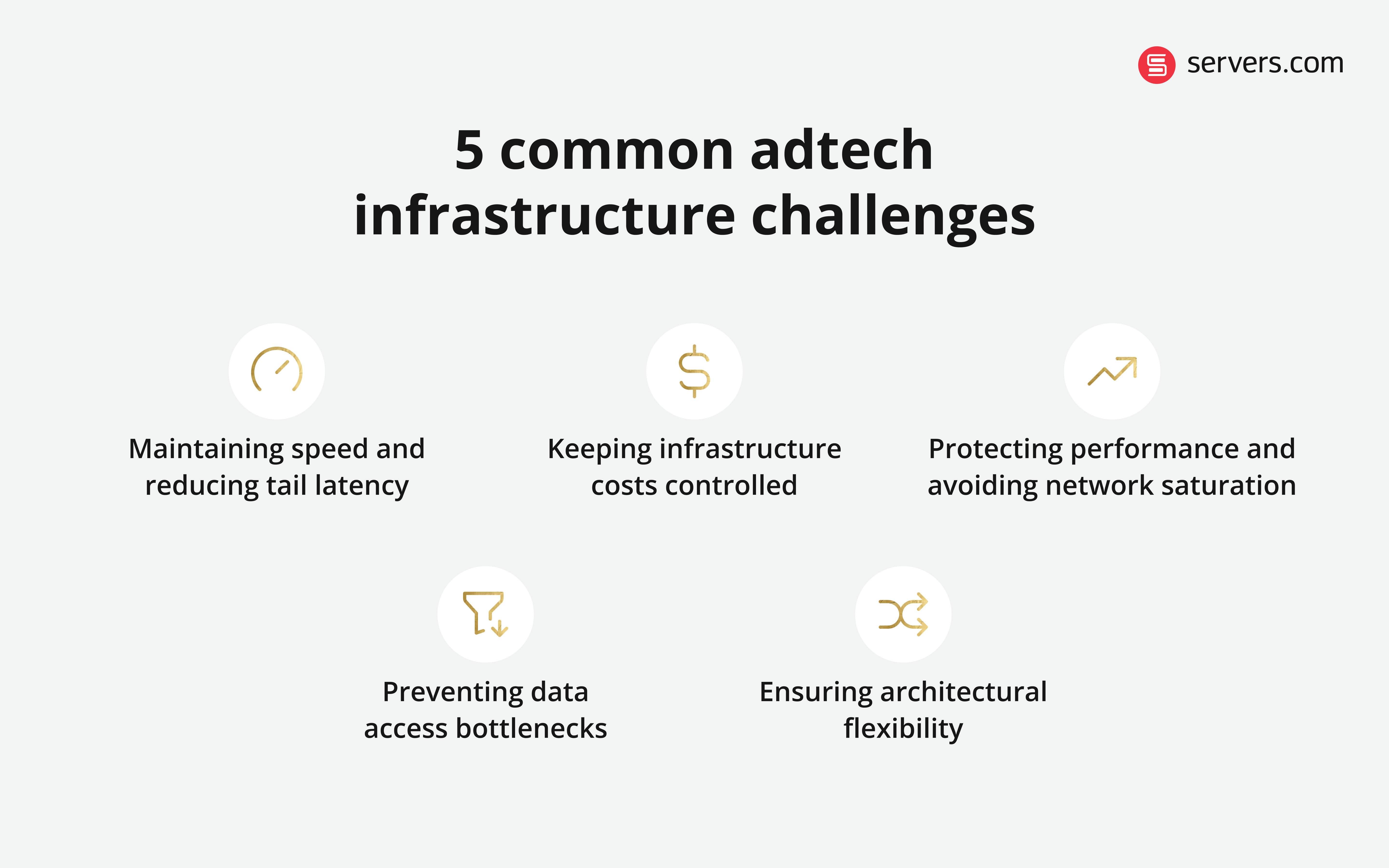
5 common adtech infrastructure challenges (and how to solve them)
1. Speed
Speed in adtech equates to how fast your system can receive a bid request, process it, make a decision, and respond. In most cases, you have less than 100 milliseconds before the opportunity disappears. If your infrastructure slows down, auctions time out. And when auctions time out, revenue drops.
Because programmatic advertising operates in real-time, you don’t get the luxury of second attempts. Every impression is a micro-transaction happening inside a strict time window. Speed directly affects win rate, fill rate, campaign performance, user experience, and revenue. Even small increases in latency can cause measurable revenue loss at scale.
To maintain speed and reduce latency in adtech, consider these infrastructure best practices:
-
Prioritize adtech infrastructure providers that offer deterministic performance
-
Keep bidding and decisioning workloads separate from analytics and background jobs
-
Deploy hardware close to traffic sources to decrease network latency
-
Track p95 and p99 response times, not just averages
-
Load test for peak conditions - your busiest day defines your real requirements
As a general principle, remember, if you can’t predict performance, you can’t protect revenue.
2. Cost
It’s not unusual for infrastructure costs in adtech to increase faster than revenue grows. Traffic spikes, inefficient configurations, unnecessary data movement, and overprovisioned systems create unpredictable bills, and already thin margins make this worse.
Most adtech business models operate on narrow spreads between buy and sell which means a small increase in infrastructure spend can eliminate margin entirely. Cost pressures increase when traffic bursts quickly, data retention expands, bandwidth and egress fees accumulate, and systems are built for peak load but sit idle most of the time. Inefficient and underutilized infrastructure quickly becomes a significant financial drain.
Shared cloud environments with usage-based billing further obfuscate true resource usage, making it near impossible to accurately forecast costs. Because of this, bare metal cloud can help optimize ROI in adtech because these solutions are single tenanted, offering full visibility over your resource usage, and direct hardware-level control.
To keep your infrastructure costs controlled, consider these infrastructure best practices:
-
Track unit economics, measuring cost per million bid requests or cost per campaign
-
Separate steady and burst workloads, creating best-fit architectures for each
-
Right-size regularly, auditing unused capacity and eliminating underutilized services
-
Monitor data transfer costs especially for cross-region external data movement
-
Align architectures to workload shape (real-time, batch, analytics workloads)
Remember, visibility into cost is the first step toward achieving predictable billing in adtech.
3. Bandwidth
Bandwidth is the volume of data moving in and out of your systems. In adtech, that data comes from your bid requests, creative delivery, user signals, log files, reporting feeds, and partner integrations. It means traffic rarely grows slowly and is more likely to spike suddenly.
This is because adtech platforms routinely process billions of requests per day. When dealing with large scale adtech data of this kind, even minor congestion can cause a ripple effect. This may appear as dropped bid requests, throttled connections, slower ad rendering, or missed revenue opportunities. Bandwidth constraints show up as performance issues, but the root cause is usually network saturation.
To avoid network saturation and protect performance, consider these infrastructure best practices:
-
Plan for peak (not just average) traffic
-
Keep frequently communicating services close to avoid unnecessary data movement
-
Use caching for common lookups and creative assets
-
Monitor throughput and saturation in real time
-
Avoid cross-region chatter unless absolutely necessary
Try reframing data movement as a fundamental part of scaling as much as a basic compute requirement.