Network
Table of contents
Streaming platforms operate in one of the most performance-sensitive corners of the digital economy. Viewers expect instant playback, consistent quality, and zero interruptions - especially during live events. Infrastructure decisions directly impact viewer experience and business growth.
Increasingly, organizations are choosing bare metal cloud providers like servers.com to power their streaming workloads. Bare-metal-as-a-service (BMaaS)solutions offer the reliable performance, deep customization, and exceptional support needed for performance-critical workloads, alongside predictable billing to help control spend.
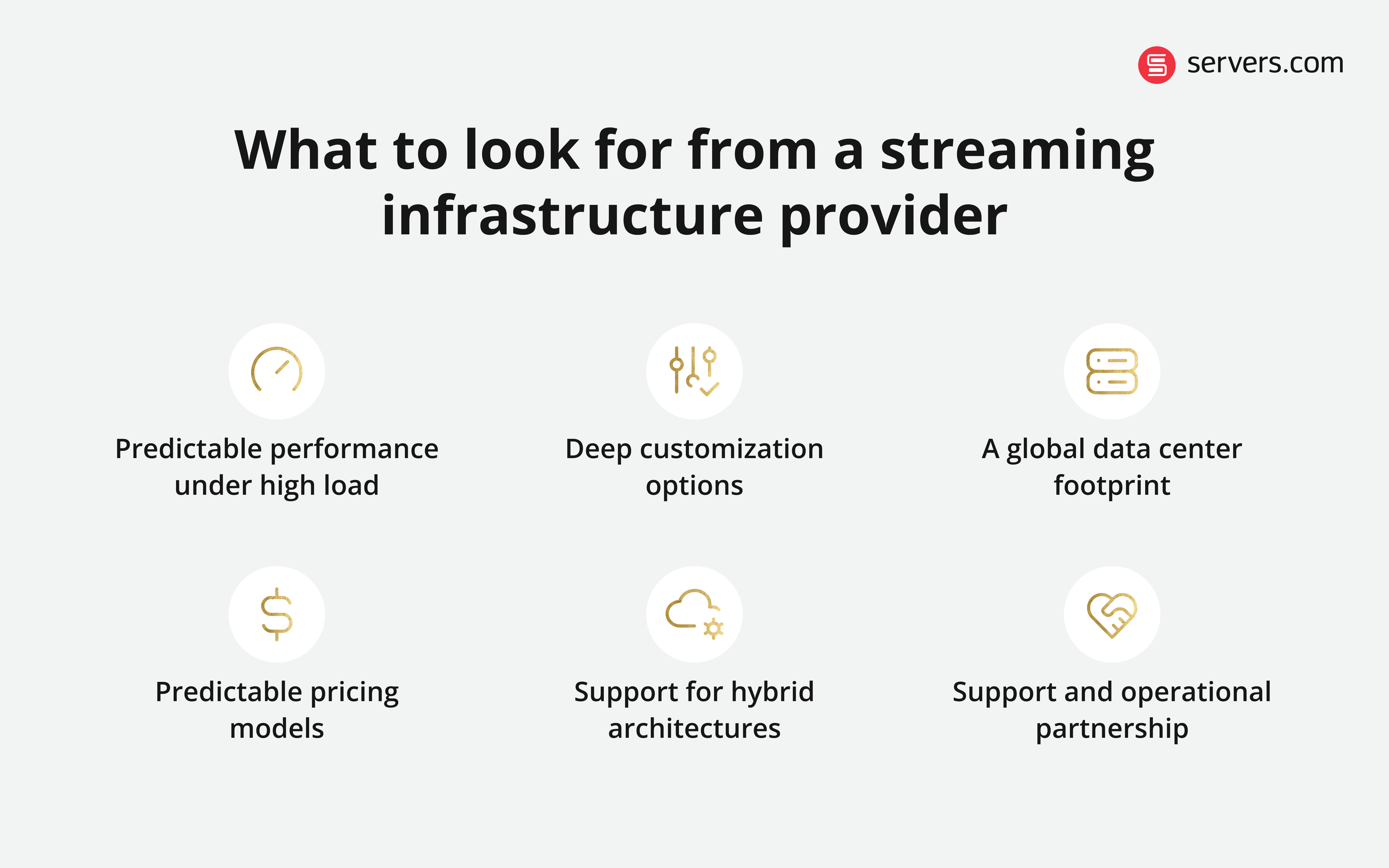
Whether you’re in the market for a new infrastructure partner for your streaming workloads (or adding additional vendors to your hybrid mix), these are our six top tips for evaluating streaming infrastructure providers.
Streaming workloads rarely fail during quiet periods. Performance problems usually surface during demand spikes that exceed the capacity or capabilities of the supporting infrastructure. If this happens consistently it causes reputation loss and churn. Research shows that viewers begin abandoning content if streams take longer than two seconds to start, and even a one-second delay can increase abandonment rates by nearly 6%.
Application-layer improvements mitigate these problems but will not fully compensate for an unstable hardware foundation or under provisioning. When compute and networking performance fluctuate it results in buffering and degraded viewing experiences. Worse, when demand exceeds compute capacity, it results in reputation ruining downtime.
Dedicated servers for streaming provide a measurable advantage because they remove virtualization overhead and eliminate resource contention caused by shared multi-tenant environments. This provides the predictable throughput, stable encoding performance, and consistent delivery quality required by streaming environments. Modern bare metal cloud solutions are also highly scalable, which means there’s no performance or scalability trade-off to negotiate.
servers.com specializes in single-tenant bare metal cloud infrastructure designed specifically for throughput-heavy streaming workloads. Dedicated Enterprise Bare Metal (EBM) server solutions offer streaming platforms full control to design and deploy performance-optimized hardware for steady state workloads. Then when demand spikes, tapping into Scalable Bare Metal (SBM) provides on-demand bare metal compute that keeps streams smooth during periods of unexpected traffic. It’s a product architecture that helps ensure performance remains stable even under sustained concurrency and peak traffic.
Performance stability is one of the top reasons More Screens chose to partner with servers.com. As a research and development company specializing in multi-screen video delivery solutions, More Screens’ workloads rely on a reliable compute foundation.
“servers.com has enabled us to deliver hundreds of Gbit/s of stable streaming service at peak times. So, it’s a perfect match for a live streaming service like ours,” said Haris Zukanović, CTO of More Screens.
Streaming workloads vary widely depending on format, monetization model, and geographic distribution. As a result, standardized cloud offerings tend to force streaming platforms into non-optimal environments that pit performance, scale, and spend against each other.
A custom bare metal solution allows streaming platforms to align hardware configurations with workload requirements. CPU architectures can be optimized for encoding, storage configurations can be tailored for high-throughput media processing, and network interface designs can be adjusted to improve delivery speed. Over time, customization also becomes a cost and efficiency advantage. When workloads match infrastructure precisely, overprovisioning is eliminated meaning less wasted compute and spend.
servers.com specializes in working with streaming platforms to build fully bespoke dedicated server configurations. Our customers can customize operating systems, memory capacity, disk architecture, RAID configurations, and networking interfaces. This flexibility allows engineering teams to fine-tune environments specifically for encoding pipelines, playout workflows, and video-on-demand delivery operations.
This level of customization is why low-latency live video streaming companies like Ceeblue choose servers.com. Together we’ve co-developed hardware, optimized to Ceeblue’s needs:
“servers.com knows our industry well and works closely with our team to tailor offerings that make sense, case by case,” said Danny Burns, Founder and CTO at Ceeblue.
“We’ve collaborated to co-develop all the hardware that we currently deploy and many of our most recent cutting-edge advances have taken place on servers.com hardware,” said Jonas Blötz, VP of Engineering at Ceeblue.

To effectively reduce latency, round-trip time, and improve playback quality you need infrastructure partners that can get you close to viewers. Streaming organizations may also need to place hardware in specific regions to adhere to regional content distribution and evolving data sovereignty and data residency mandates. On top of this, multi-region architectures strengthen redundancy in the event of region-based outages.
All of this means hardware location availability is a critical evaluation criterion. When weighing up vendors, you should go deeper than just checking their data center location maps, and ask the following questions:
Can hardware be placed in specific cities or are offerings limited to broad regional zones? – for latency-sensitive workloads the more geographically specific the better.
How are new data center locations selected? – seek vendors that actively expand their data center locations based on streaming demand hubs and customer demand.
Geographic coverage alone only takes you so far, however. Network quality determines how effectively traffic moves between those data centers and end users. Carrier diversity, redundant routing, and high-bandwidth connections are equally essential criteria for maintaining stable delivery performance.
servers.com operates a globally distributed, customer-led, infrastructure footprint across North America, Europe, Asia Pacific, and Latin America. Facilities are strategically located near connectivity hubs and major internet exchange points to reduce latency and improve reach.
Marat Gainullin, Head of Service Delivery at servers.com shares some context to servers.com’s latest data center launch in São Paulo, Brazil:
“Our decision to launch in São Paulo was a direct response to what our customers have been telling us. They needed reliable, high-performance compute closer to their users in Latin America. São Paulo is one of the most strategically important digital hubs in the world, and expanding here strengthens our global infrastructure footprint while enabling our clients to deliver lower-latency, regionally compliant services at scale.”
Each servers.com deployment also connects to multiple physically isolated networks, including a public internet network, an out-of-band management network, and a Global Private Network delivering up to 20 Gbps connectivity per server. This architecture ensures consistent performance, fast failover, and predictable latency for real-time workloads.
For streaming organizations expanding into new markets or delivering regionally licensed content, this combination of geographic reach and network engineering is a major competitive advantage.
“servers.com knows our industry well and works closely with our team to tailor offerings that make sense, case by case.” - Danny Burns, Founder and CTO at Ceeblue.
Streaming platforms face unique cost challenges, particularly related to bandwidth and egress pricing. As audience concurrency increases, usage-based pricing models often scale non-linearly, making it difficult to forecast infrastructure spend or align costs with revenue growth.
Cost volatility can undermine financial planning and reduce profitability during high-demand events. Streaming organizations can, therefore, benefit from prioritizing infrastructure models that provide transparent and predictable cost behavior as traffic scales.
Dedicated, bare metal cloud environments stabilize bandwidth pricing by eliminating shared-resource variability and providing clearer cost structures tied to infrastructure allocation rather than unpredictable usage spikes.
servers.com supports cost predictability through transparent pricing models and dedicated infrastructure. This allows streaming businesses to forecast delivery costs accurately and scale audiences without introducing unexpected cost volatility.
“servers.com has enabled us to deliver hundreds of Gbit/s of stable streaming service at peak times. So, it’s a perfect match for a live streaming service like ours.” - Haris Zukanović, CTO of More Screens.
Few streaming organizations rely on a single infrastructure environment. Many architectures combine dedicated bare metal for persistent performance-heavy workloads with public cloud resources for burst capacity and development flexibility. For instance, long-lived encoding or playout workflows often benefit from dedicated infrastructure, while short-lived or experimental workloads may remain in cloud environments.
Likewise, even bare-metal-first streaming architectures typically employ multiple bare metal providers for geographic diversity and increased resilience. Your infrastructure provider should support a hybrid approach rather than pushing you toward single-vendor dependency.
servers.com designs infrastructure strategies based on each customer’s workload requirements. Where a fully dedicated servers.com deployment is optimal, the company supports that approach. Where multi-vendor or hybrid architectures deliver better outcomes, servers.com actively facilitates those designs.
This workload placement strategy optimizes long-term outcomes allowing streaming platforms to evolve incrementally without disruptive re-architecture.
Infrastructure failures are inevitable. What determines business impact is how quickly and effectively providers respond. Streaming outages can cause immediate revenue loss, reputational damage, and customer churn.
The average cost of IT downtime can exceed $5,600 per minute, and streaming incidents often include additional expenses such as refunds, make-good advertising credits, and post-incident remediation. Because of this, support quality should be treated as a core performance factor, not an afterthought. Streaming providers need infrastructure partners that act as extensions of their engineering teams.
servers.com delivers 24/7/365 human-first support with direct access to experienced engineers and dedicated account management. Tickets are handled by qualified specialists rather than multi-tier escalation chains, ensuring faster resolution and clearer communication during critical incidents. And beyond reactive troubleshooting, servers.com collaborates with customers during onboarding, architecture design, and ongoing optimization. This proactive partnership helps prevent performance issues before they impact viewers.
“Whether you’re running a single server or an entire fleet, world-class infrastructure demands world-class support and that’s how we do things at servers.com. There’s no place for favoritism - every customer is a priority and gets the same human-first service,” shares Isaac Douglas, CRO of servers.com.
Streaming organizations operate in an environment where performance instability and cost unpredictability can threaten both audience experience and long-term growth. servers.com’s specialists address these streaming infrastructure challenges through a combination of purpose-built infrastructure and operational expertise.
By choosing servers.com, streaming platforms gain:
Dedicated single-tenant infrastructure optimized for latency-sensitive workloads
Predictable bandwidth and egress cost models
Fully customizable hardware and network configurations
Globally distributed data center locations with advanced networking
Hybrid-ready infrastructure that preserves architectural flexibility
24/7/365 human support designed to act as an extension of internal teams
Whether you’re running a single server or an entire fleet, world-class infrastructure demands world-class support and that’s how we do things at servers.com.” – Isaac Douglas, CRO, servers.com.
Streaming competition continues to intensify, and viewer expectations are rising with it. Platforms that treat infrastructure as a strategic foundation are better positioned to deliver consistent performance, protect revenue streams, and adapt to audience demands.
Partnering with infrastructure providers that deliver predictable performance, transparent cost models, global reach, and exceptional support provides a measurable advantage for streaming businesses operating at scale. And servers.com’s performance-focused, hybrid-ready bare metal solutions are designed specifically for performance-critical streaming workloads.
If you’re interested in the benefits of bare metal servers for streaming or already evaluating infrastructure partners, speak to our experts to discuss your use-case.

Frances is proficient in taking complex information and turning it into engaging, digestible content that readers can enjoy. Whether it's a detailed report or a point-of-view piece, she loves using language to inform, entertain and provide value to readers.