Achieving consistency
Under sustained auction load, performance metrics that would otherwise appear stable can drift into unpredictable response times, complex scaling rules and latency variations. The fact is that many environments are designed to scale capacity in bursts, not to guarantee consistency over time.
The question then shifts from how well your platform scales, to how consistently it behaves when pressure never really drops. And that’s where infrastructure design starts to matter - particularly in three key areas that directly shape bidding performance under sustained load.
Deterministic compute for bidder paths
The often-overlooked reality of shared environments is that workloads compete for resources. For adtech, this means bidders may be competing with unrelated processes on the same hardware before they can respond within auction deadlines. This introduces latency variability that only becomes visible under sustained load, and when every response has a deadline, that variability quickly translates into missed opportunities.
servers.com’s EBM removes that uncertainty. By providing sole ownership over compute resources, EBM eliminates the risk of noisy neighbours, offering high, dedicated performance with no resource contention.
Flexibility meets consistency
For many adtech platforms, the challenge is not choosing between cloud and dedicated infrastructure but finding a way to balance the elasticity of one with the dependable performance of the other. Before working with servers.com, GeoSpot Media had worked with both cloud-based and dedicated server providers. As Agarwal explains:
“Cloud solutions provided flexibility but lacked the consistent low-latency performance we required at scale. On the other hand, the dedicated server providers we worked with offered performance, but were less flexible in terms of rapid deployment and geographic coverage.”
This is where servers.com bare metal solves both of these issues - EBM is often deployed alongside Scalable Bare Metal (SBM), combining dedicated, deterministic performance with cloud elasticity.
SBM enables bare metal servers to be deployed within minutes on an hourly billing model, making it easy to introduce additional capacity when demand increases without adding opaque pricing mechanics or shared-resource constraints. Built on dedicated, pre-defined hardware configurations, SBM lets adtech teams expand by adding like-for-like nodes, maintaining steady performance profiles and clear cost expectations as they scale.
With this setup, you are able to maintain the low-latency consistency needed for revenue-critical bidding paths while still handling demand peaks without operational friction.
For platforms like GeoSpot Media, a hybrid environment provides them with infrastructure that behaves predictably under sustained auction load, without sacrificing the agility required to grow and adapt as traffic patterns grew.
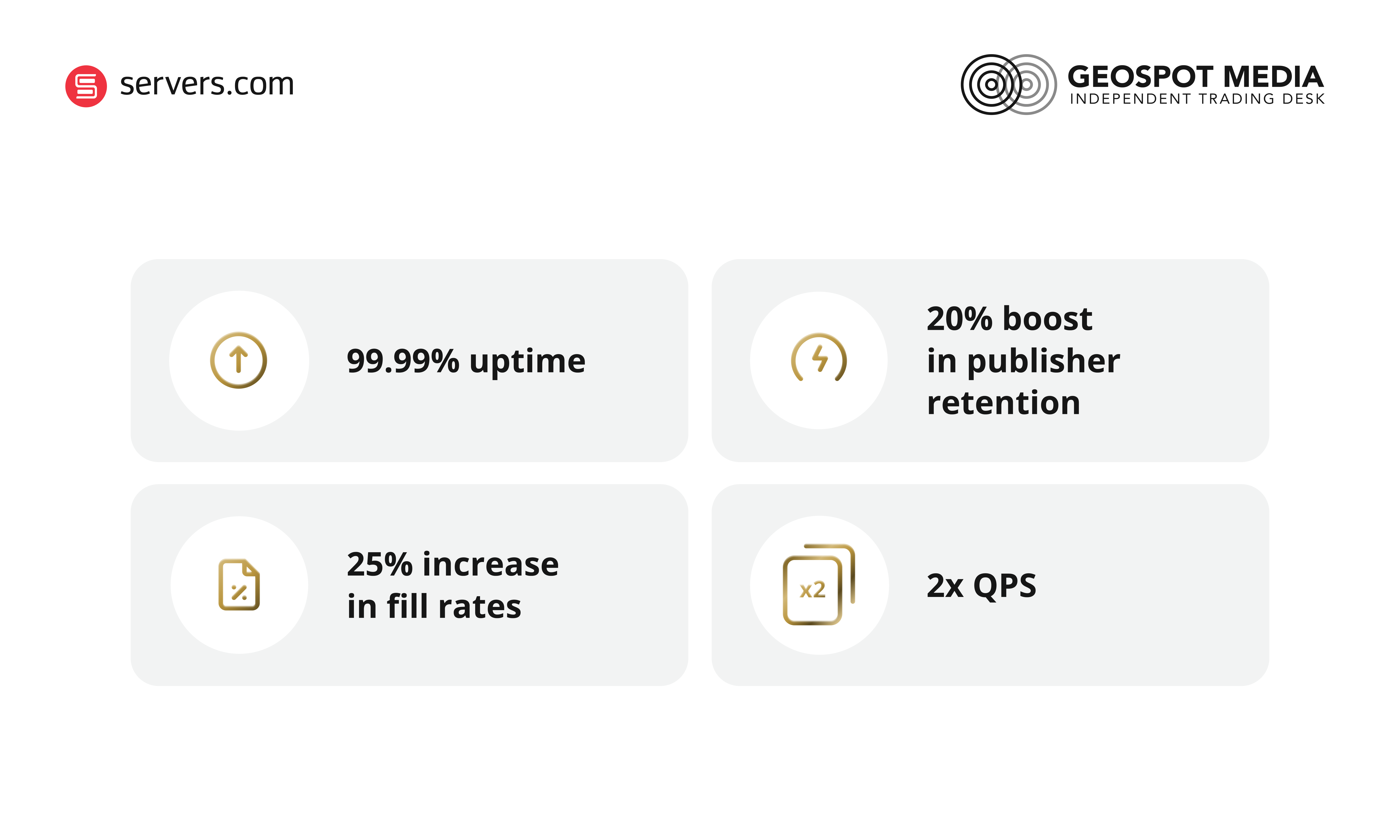
“servers.com’s infrastructure supports our demand for consistent uptime and fast response times, enabling us to handle double the previous QPS without any latency issues.”
Stable performance during sustained high QPS
When high QPS loads persist for hours, differences between nodes, network paths or provisioning timings can create subtle performance drifts, even when systems appear to be scaling correctly on paper.
EBM reduces variability between workloads, while SBM allows for additional capacity to be brought online without introducing unpredictable execution behaviour. If you were to find that near-instant scalability with hyperscale cloud, you would still have the risks that come with resource contention. SBM gives you that scalability, without any of the side effects.
For high-load platforms like GoNET, consistency under pressure is essential. As Halchevsky explains, “the reliability and stability of our infrastructure is paramount,” particularly when serving high request volumes where even small delays can compound into measurable performance impact.
When infrastructure behaviour becomes predictable
What these examples highlight is that sustained auction performance is about ensuring that infrastructure behaves the same way when demand rises as it does during normal operation.
Deterministic compute, flexibility without compromise, and stable execution under high QPS combine to create an environment where engineering teams can focus on optimisation and innovation, rather than compensating for infrastructure variability. And when execution stays consistent, bidding performance becomes something you can rely on.
The results that GeoSpot Media found once they migrated their infrastructure to servers.com speaks for themselves: