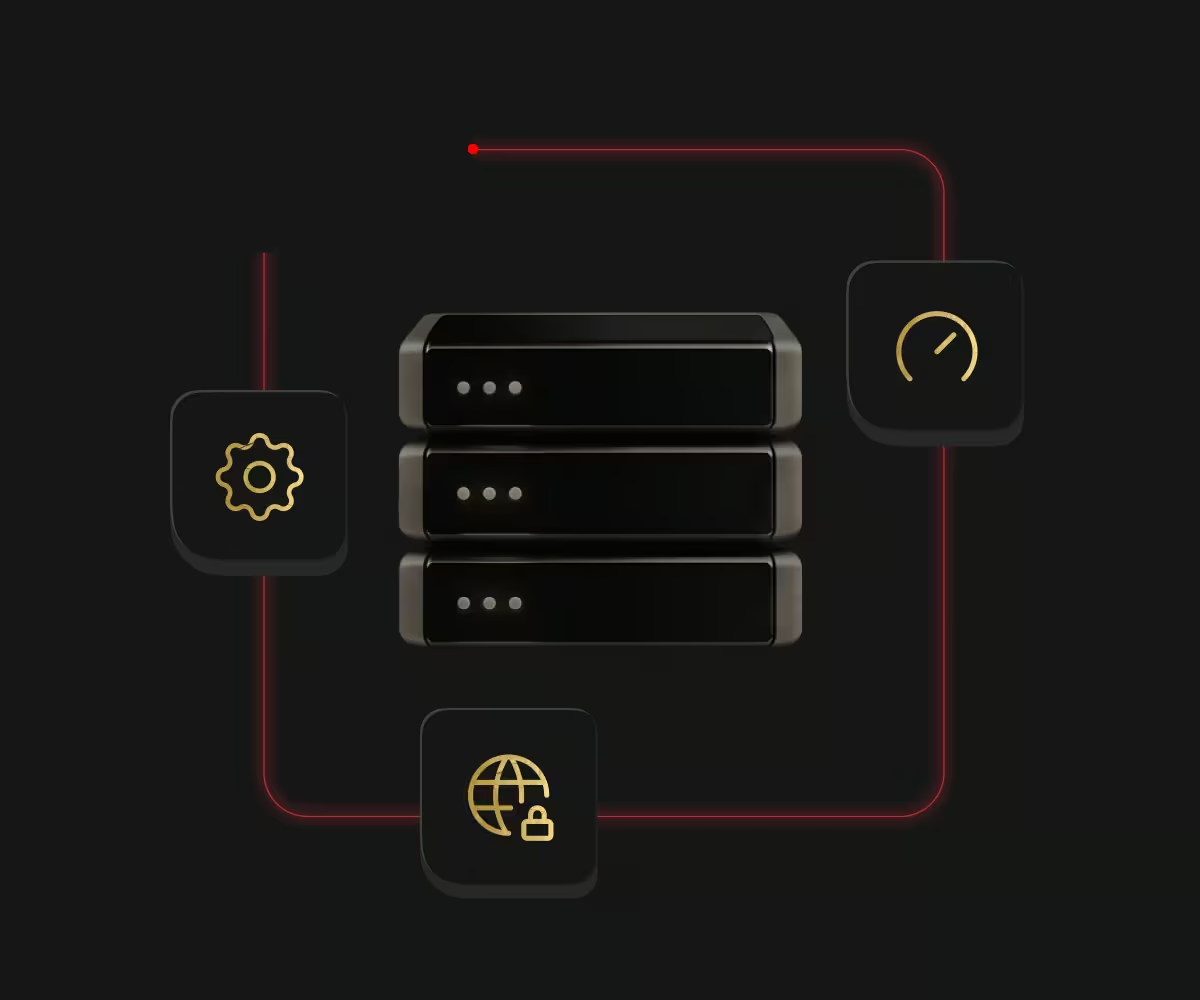
Enterprise Bare Metal is for platforms with a steady floor of demand that runs around the clock, where consistent performance and a predictable monthly bill matter more than renting by the hour.
Ad exchanges, game servers, and streaming origins carry load every hour of the week, which is exactly the pattern monthly billing suits best.
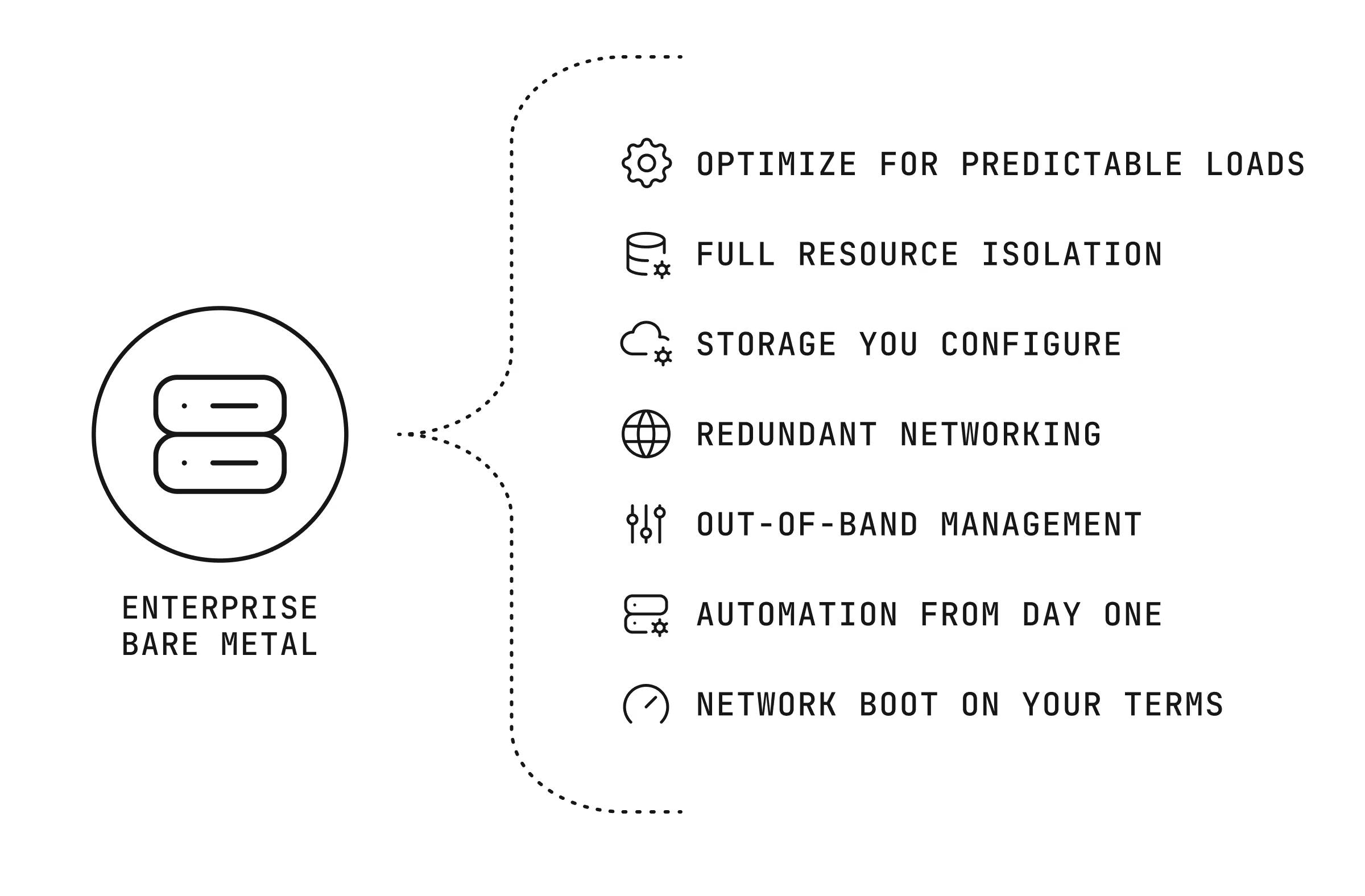
Move the always-on part of your workload to dedicated enterprise bare metal to optimize cost and performance.
Keep root access and full hardware control without buying hardware for every new region or refresh cycle.
You get the whole server and the essentials to run it, included in the monthly price. Extras such as memory and disk upgrades, additional internet protocol (IP) addresses, paid operating systems, and larger traffic packages cost more.
You have full control over your dedicated hardware and the flexibility to customize it to your workload requirements.
Dedicated CPU, memory, and storage resources with no shared compute capacity or noisy neighbors affecting your performance down.
Choose the disks, set up redundant array of independent disks (RAID) to combine them for speed or redundancy, and work directly with the controllers and backplanes.
Two connections to separate public switches, two to separate private switches, and a fifth for management, bonded so one failed Link doesn’t take the server offline.
Out-of-band (OOB) management is a controller built into every server. It lets you power on, diagnose, and reinstall a server even when its operating system is down or the server is powered off.
Order, configure, reinstall, and release servers through the Customer Portal, the public application programming interface (API), our SCL (srvctl command-line tool), or Terraform, a tool that builds infrastructure from code.
Boot from your own iPXE network boot script on every start, over the public or private network, without going through the standard installer.
Choosing an Enterprise Bare Metal chassis starts with the workload, because the chassis fixes the processor sockets, power supplies, and drive slots, while memory and disks can change later.
| Chassis family | What it is | Suits |
|---|---|---|
| Supermicro H13SRD-FR2xx | One AMD EPYC 4000-series processor, 8 to 16 coresOne processor and one power supply, one rack unit tall | Lighter services and distributed work where each server is one of many |
| Dell PowerEdge R470 and R570R3xx | One Intel Xeon 6 processor, 16 cores, one rack unit tall (R470) or two (R570)One processor with two power supplies, one rack unit tall | Steady single-processor workloads that don’t need a second socketThe same work where a failed power supply can’t stop the server |
| Dell PowerEdge R670 and R770R4xx | Two Intel Xeon 6 processors, 48 to 64 cores, one rack unit tall (R670) or two (R770)Two processors, one rack unit tall | Workloads that need more memory and more connections for add-in cards |
| Dell PowerEdge R6715 and R7715R66xx | One AMD EPYC 9005-series processor, 32 to 96 cores, one rack unit tall (R6715) or two (R7715)One processor (R6615) or two processors (R6625), AMD-based, one rack unit tall | Compute-heavy and data processing workloads that need high core counts on a single processorWorkloads that need more memory and more connections for add-in cards |
Every chassis takes memory and disk upgrades, extra internet protocol (IP) addresses, paid operating systems, and larger traffic packages. If you want a custom build, our solution architects can help you choose the hardware and network setup, so your workload gets the best possible performance.
EBM is customizable dedicated server hosting billed by the month. With options to tailor RAM and storage or to create fully bespoke dedicated servers (for long term agreements), EBM offers control and customization – without compromising on performance.
If you want to see configurations and pricing you are welcome to create a profile on our customer portal and use the Order process. If these options don’t quite meet your need, talk with our expert sales team to design something more aligned to your need.
| Component | Self-Service Options |
|---|---|
| Dell PowerEdge Servers or Supermicro | R4xx, R5xx, R6xx, R7xx, H13SRD-F |
| RAM | 32 GB - 2 TB |
| Operating System | Ubuntu, Debian, AlmaLinux, Rocky Linux, Windows, Proxmox, VMware ESXi, CentOS, Talos Linux, FreeBSD, without OS |
| RAID Storage | 1, 10, 5, 6, 0, 50, 60, JBOD |
| Public Uplink | 1 Gbps with or without redundancy, 10 Gbps with redundancy |
| Private Uplink | 1 Gbps with or without redundancy, 10 Gbps with redundancy |
| Bandwidth Plan | By traffic amount, by 95th percentile |
| Isolation | Shared racks, private racks, private data center (minimum 4 racks) |
What Enterprise Bare Metal changes shows up in three places, the bill, the response times your customers see, and the work your team does to keep both steady.
The baseline gets a fixed monthly price, and dedicated servers costs up to 50% less than the same workload on a hyperscaler, one of the giant public clouds such as Amazon Web Services, Google Cloud, or Azure.
High-performance enterprise bare metal servers sized to the workload on a hyper-sale grade network with active-active redundancy on both private and public networks.
Take full control of your infrastructure with root access, out-of-band management, and the flexibility to deploy your own operating system images.
Servers are billed on a fixed fee per month.
What we need to know to quote Enterprise Bare Metal is how the workload behaves today, because those answers decide the build.
How many servers or instances run the baseline today, and how busy they are across a normal week.
Whether the workload is limited by processor, memory, disk, or network, and any response time the business has promised its customers.
Where your users, partners, or regulators sit, which decides the data centers we propose.
Expected outbound traffic each month, and how much moves between your own servers.
How long the workload will run, because longer agreements open fully custom builds.
Enterprise Bare Metal (EBM) compared with Scalable Bare Metal (SBM) comes down to whether the work is steady or temporary, and most platforms run both on one account and one private network.
Moving your baseline to Enterprise Bare Metal happens in phases, so nothing changes for your customers until the new environment has proved itself.
A solution architect reviews your current setup and marks which workloads run flat all week and which ones spike.
We provision the servers, your team installs its stack through the application programming interface (API) or Terraform, and both teams test under real load before any traffic moves.
Traffic moves one workload at a time, starting with the steadiest, while the old environment stays live as a fallback.
The infrastructure, the network, and the people come from one provider that designs around the workload.
Every server we rent belongs to one customer, and no proprietary service sits between your software and the hardware, so moving away never means rewriting your platform.
Data centers across North America, South America, Europe, and Asia Pacific, joined by a private network with free transfer between sites.
The Customer Portal, a public application programming interface (API), a command-line tool, and Terraform work across the catalog, with the same hardware profiles in every region.
The engineers and account managers who help design your environment are the ones who help you migrate it and run it.
Support from engineers, backed by a team that knows your environment, is part of every product we sell, and it doesn’t depend on how much you spend with us.
Engineers answer your messages 24 hours a day and every day of the year, and your account team brings the context of your environment.
Your account managers stay with you for the life of the relationship, from the first call onward.
Architects take part in design, migration, and later changes, so decisions get made with the workload in view.
We work in your Slack, Discord, Teams, Telegram, or WhatsApp instead of asking you to learn a ticket system.
No. Enterprise Bare Metal is a physical server with no virtualization layer, so there’s no hypervisor overhead and no other customer on the hardware.
The server with its space, power, and cooling, public and private networking, a public IP address, automated operating system installation, out-of-band access, replacement of failed parts, and 24/7 support. US and EU locations also include 20 terabytes (TB) of outbound traffic each month.
Yes. Install any operating system through out-of-band management, including custom images, or use our Linux, Windows, and BSD templates for automated installation.
Connect over Secure Shell (SSH), Remote Desktop, the console in the Customer Portal, or out-of-band management, and manage the server through the portal, the API, or our Terraform provider.
Dell PowerEdge and Supermicro servers form the core of the fleet, all on enterprise components.
Enterprise Bare Metal is sized for the steady part of the workload. For spikes, add Scalable Bare Metal on the same account and private network, and release it when the peak passes.
We suggest the nearest available build or order custom hardware, and provisioning time then follows the delivery date.

A solution architect maps your current setup and models what the same workload costs over the next 12 to 36 months at your current growth.