Back

Rebuilding the streaming stack: how hosting choices reduce latency and viewer churn

Rebuilding the streaming stack: how hosting choices reduce latency and viewer churn

Over the last decade, most innovation in streaming has happened at the application layer. Software players have improved, codecs and streaming protocols have advanced, and content delivery network (CDN) strategies have gotten smarter. But one part of the ecosystem hasn’t evolved at the same pace: streaming infrastructure.

That gap now matters more than ever. With viewers expecting near-instant start times and exceptional quality (especially for live content), competition is fierce. Achieving low latency in live video streaming has always been important but now it’s a critical success metric that directly impacts end-user engagement, loyalty, and revenue.

It means streaming platforms can no longer rely solely on software optimizations alone to improve viewership. Instead, they need to rebuild from the foundation up: starting with the infrastructure that underpins their services.

How hosting choices impact viewer churn

Latency is one of the biggest challenges in streaming because of its direct connection to viewer abandonment. Time-to-first-frame (TTFF), buffering, and end-to-end latency all influence whether a viewer will settle into a stream or leave within seconds.

As Strategic Advisor, Carlo De Marchis puts it: “Over a decade ago we argued about whether 30-second OTT delay was acceptable. By 2025 the debate is no longer abstract: latency targets are now mapped to concrete business models.”

During high-stakes live events, latency becomes even more critical. Research shows that viewers start to abandon content that doesn’t start up within two seconds and that even a one second incremental delay increases viewer abandonment by 5.8%.

CDNs and player optimizations help, but these problems originate deeper in the stack. If the underlying infrastructure can’t deliver predictable throughput and stable performance, the upper layers can only compensate so much.

By 2025 the debate is no longer abstract: latency targets are now mapped to concrete business models.

Why hyperscale cloud isn’t always built for streaming

Hyperscale cloud environments were engineered for general-purpose enterprise workloads not throughput-hungry, low-latency streaming. When resource-intensive streaming workloads are hosted in these environments, some common challenges emerge:

  • Virtualization taxes add overheads to encoding and packaging workloads
  • Noisy neighbours cause resource contention and inconsistent performance
  • Multi-tenant networking gets in the way of predictable delivery
  • Generic routing and caching aren’t tailored to specific media pipelines
  • Cost inefficiencies lead to paying for unneeded elasticity

Virtualized environments can’t guarantee the determinist performance that real-time video demands and live streaming workloads expose every hidden inefficiency.

As a result, hyperscale cloud use is changing. Streaming platforms are recognizing that while hyperscale cloud excels at elasticity, it needs to be combined with compute types that give control over the hardware and networking paths that govern streaming latency and throughput. This is where bare metal offers a measurable advantage.

As João Neto, CEO of VoiceInteraction told servers.com: “Our solutions demand significant computational resources and traditional public cloud solutions were unsustainable in terms of pricing and lack of control over the infrastructure.”

It's exactly why VoiceInteraction chose to mobilize bare metal cloud solutions from servers.com - and why bare metal has become a streaming hosting staple across the board.

Our solutions demand significant computational resources and traditional public cloud solutions were unsustainable in terms of pricing and lack of control over the infrastructure.

Rebuilding the streaming stack with bare metal

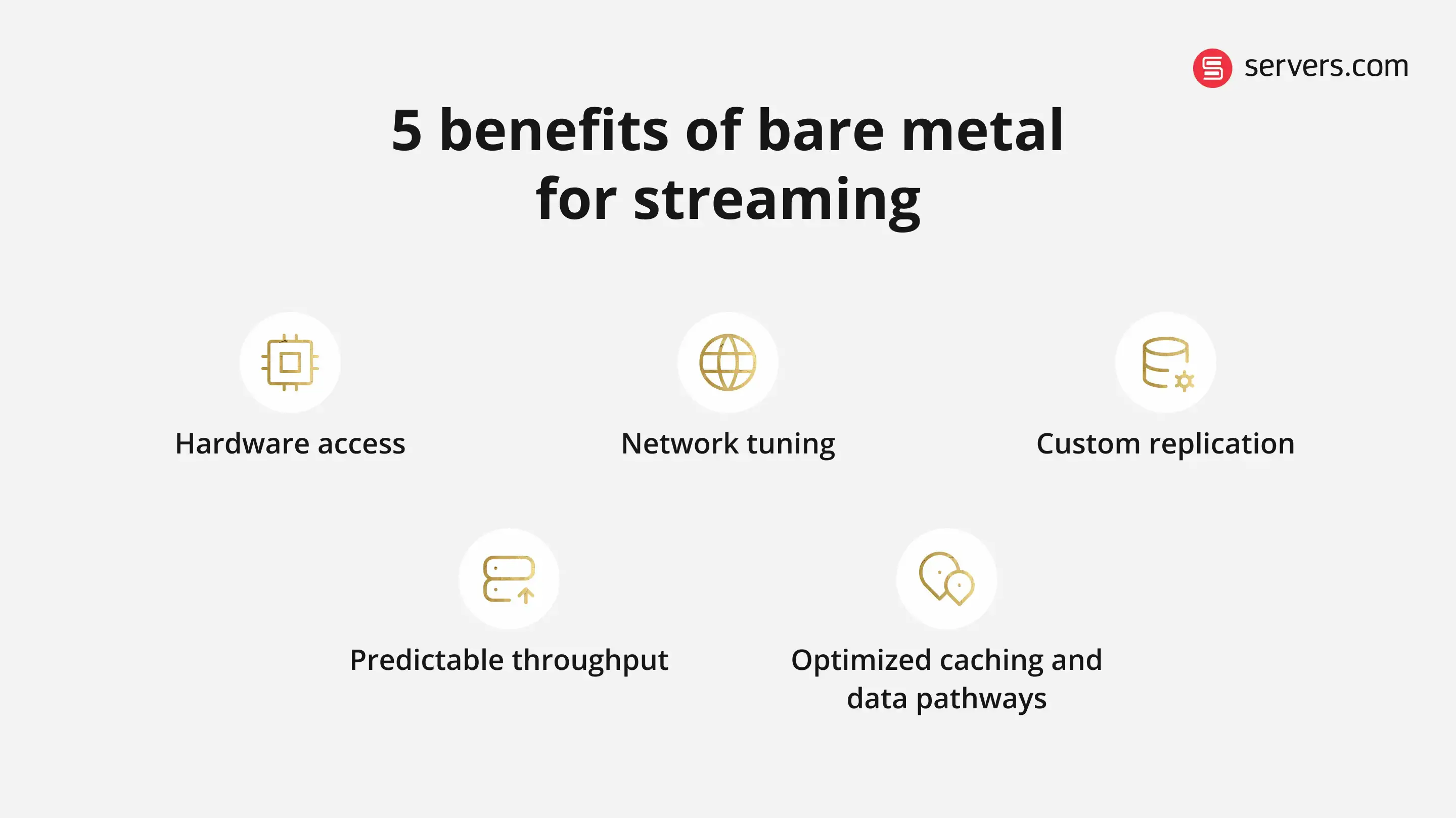
Whether owned or rented from a bare-metal-as-a-service (BMaaS) provider, bare metal solutions differ from virtualized environments primarily because they offer resource isolation. Dedicated servers for streaming give platforms sole tenancy over their hardware - and with that comes a far greater level of control. In practice that looks like:

Direct hardware access

Because there’s no virtualization layer, bare metal offers exclusive use over server resources. This is especially impactful for encoding (where hypervisors introduce unnecessary overheads), low-latency packaging workflows with tight timing windows, and high bitrate workloads where jitter from shared compute can cause visible quality degradation. Having direct access to underlying resources means workloads can be carefully optimized to a streaming platform’s specific needs, yielding significant performance improvements.

It’s exactly why Ceeblue chose bare metal from servers.com to power their low latency live video streaming platform. CTO, Danny Burns, shares:

“Cloud encoding costs are trending steadily upwards due to consolidation and the scarcity of compute caused by the AI industry’s demand for chips. Our processes are very operationally and computationally efficient, and we have full control over the configuration of our hardware footprint, so we’ve been able to buck this trend and continue to offer very competitive pricing.”

Network tuning

Bare metal lets operators configure network behavior at a much finer level. Custom MTU (maximum transmission unit) helps optimize video packet flow and tailored routing reduces dependencies on generic, multi-tenant routing layers. At the same time, traffic shaping ensures time-sensitive encoding/ingest. This added network control helps reduce jitter, packet loss, and inconsistent throughput - common contributors to latency and rebuffering.

Custom data replication

Instead of relying on one-size-fits-all replication logic, bare metal architectures can be optimized around how streaming traffic behaves. For example, to achieve regional replication, video on demand (VOD) assets may be placed closer to predictable hotspots. At the same time, latency-sensitive replication strategies can be introduced to optimize the distribution of data and reduce timing delays. This ensures content is delivered where it’s needed, when it’s needed, reducing cold-start latency and improving overall stability.

Predictable throughput

In virtualized cloud environments performance varies depending on the hardware demands of other tenants. Bare metal performance is more consistent because resources aren’t shared with other tenants and deterministic network bandwidth ensures data travels within a set time frame. This predictability is essential for continuous playout and 24/7 transcoding environments, where even small fluctuations can ripple into viewer issues. Ultimately, it creates a more stable foundation for maintaining performance during peak events.

Optimize caching logic and data paths

Bare metal infrastructure allows streaming providers to align network design with media delivery. Regional routing helps reduce unnecessary cross-zone traffic; custom caching logic supports segment-based delivery and direct peering opportunities bypass congested public networks. By controlling these elements, streaming providers minimize variability and improve consistency for global audiences.


bare metal for streaming

Right-sizing through a hybrid approach

Hyperscale cloud still plays a valuable role in scenarios that require massive elasticity: one-off global events, sudden geographic bursts, or when you need to spin up an on-demand development and testing environment fast. But not all workloads are so volatile and using hyperscale cloud in isolation leads to unnecessary cost and unpredictable performance.

For this reason, the most efficient streaming architectures take a hybrid approach, combining the strengths of both bare metal and hyperscale cloud. If you’re thinking about going hybrid with your streaming stack, consider the following practical steps:

  1. Audit latency hotspots across ingest, processing, and delivery paths
  2. Identify always-on workloads that would benefit from migration to bare metal
  3. Map traffic patterns to determine when and where you need public cloud elasticity
  4. Evaluate bare metal providers based on global footprint, network architecture, support, and provisioning speed

The table below demonstrates what an effective streaming workload split might look like.

Use bare metal for... Use hyperscale cloud for...
Persistent, performance-heavy encoding Burst capacity during high-traffic spikes
Packaging pipelines Overflow for sudden regional surges
24/7 playout On-demand testing and development
VOD delivery Short-lived workflows
Monitoring and QC
Transcoding pipelines

Infrastructure is a competitive advantage

Optimizing streaming performance requires more than new player tech or smarter CDNs. The real gains come from rebuilding the foundation. That means choosing streaming hosting solutions that minimize latency, maximize throughput, and reduce churn at global scale.

Bare metal gives streaming providers the control, predictability, and performance they need to meet rising viewer expectations. And when paired with hyperscale cloud in a thoughtful hybrid model, it creates an architecture built for both consistency and agility.

As competition intensifies, infrastructure is one of the most strategic levers for streaming platforms and how to improve streaming viewership long-term.

Author: Frances Buttigieg

Frances Buttigieg, Senior Content Writer

Frances is proficient in taking complex information and turning it into engaging, digestible content that readers can enjoy. Whether it's a detailed report or a point-of-view piece, she loves using language to inform, entertain and provide value to readers.

Related articles